
Access, Not Chances: How Como Took Manchester United Apart – LC
Como beat Manchester United 4-1 — and in this case the scoreline really is a fair expression of the game. For long stretches the match was one-sided, not in terms of chance volume but in terms of access: Como dictated in every phase where the ball went, who received it, and under what conditions it had to be played on. United never got on terms in any of those phases.
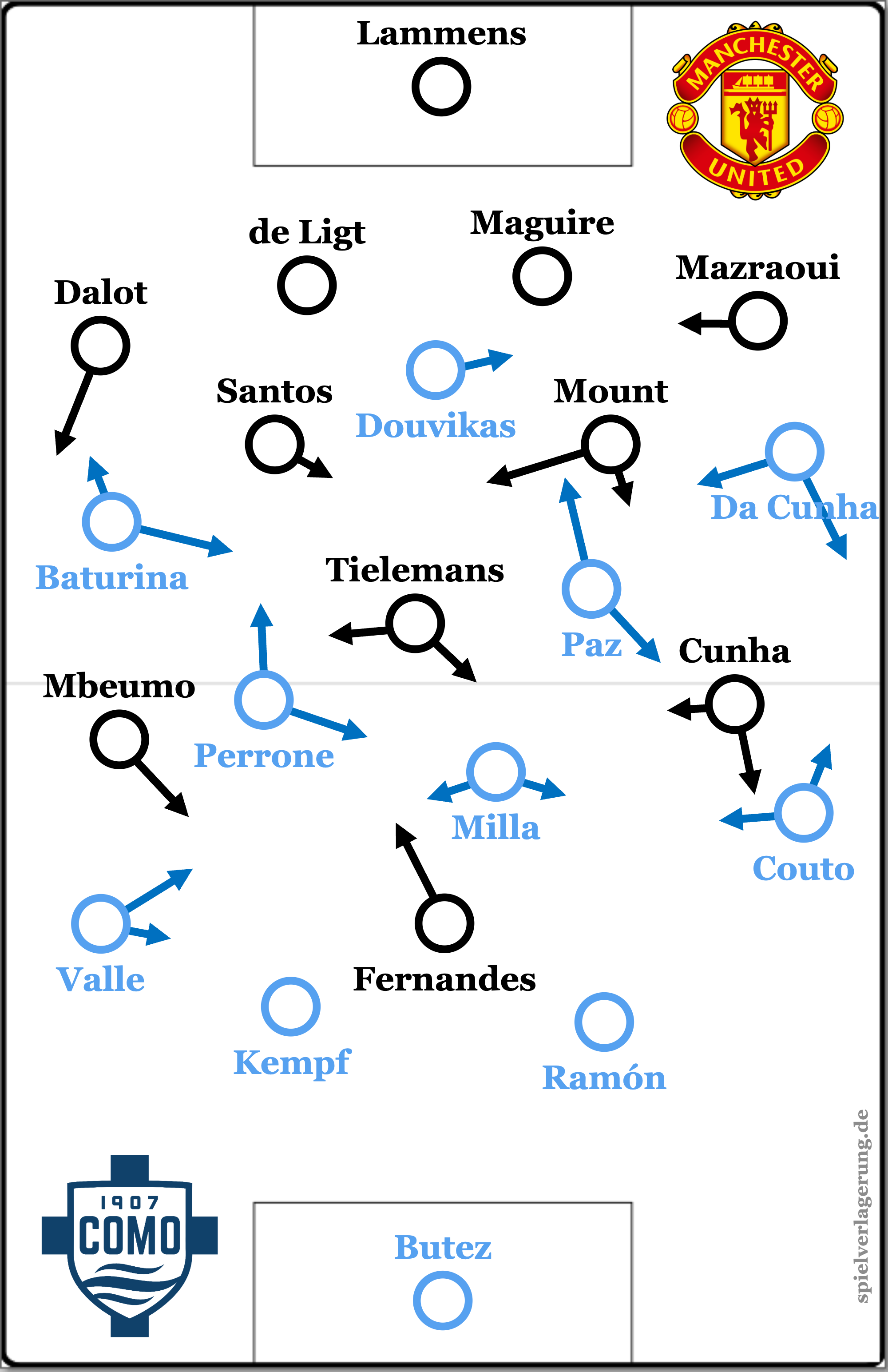 Cesc Fàbregas’s side showed two things that rarely go together. Out of possession, a pressing structure with clear direction, isolation of one side, and man-marking that applied near the ball only for the action in progress while everything around it was already speculating on the second ball. And in possession, a positional game of remarkable technical maturity that ties opponents in, switches play, and works systematically into the space behind them. The 4-1 is therefore less an outlier than evidence of work that has been built up over recent seasons.
This analysis goes through the phases one by one: first Como in possession and United’s response, then the work against the ball from the high press to defending the box, and finally the goals.
Como build up, United can’t get near
In build-up, Como moved away from their nominal 4-2-3-1 and sat closer to a 4-3-3, with the eights as the real variable: very free in their movement and above all active in the half-spaces. The base structure stayed stable — a flat four plus a six in front of them, sometimes ahead of the line, sometimes slightly behind the forward line.
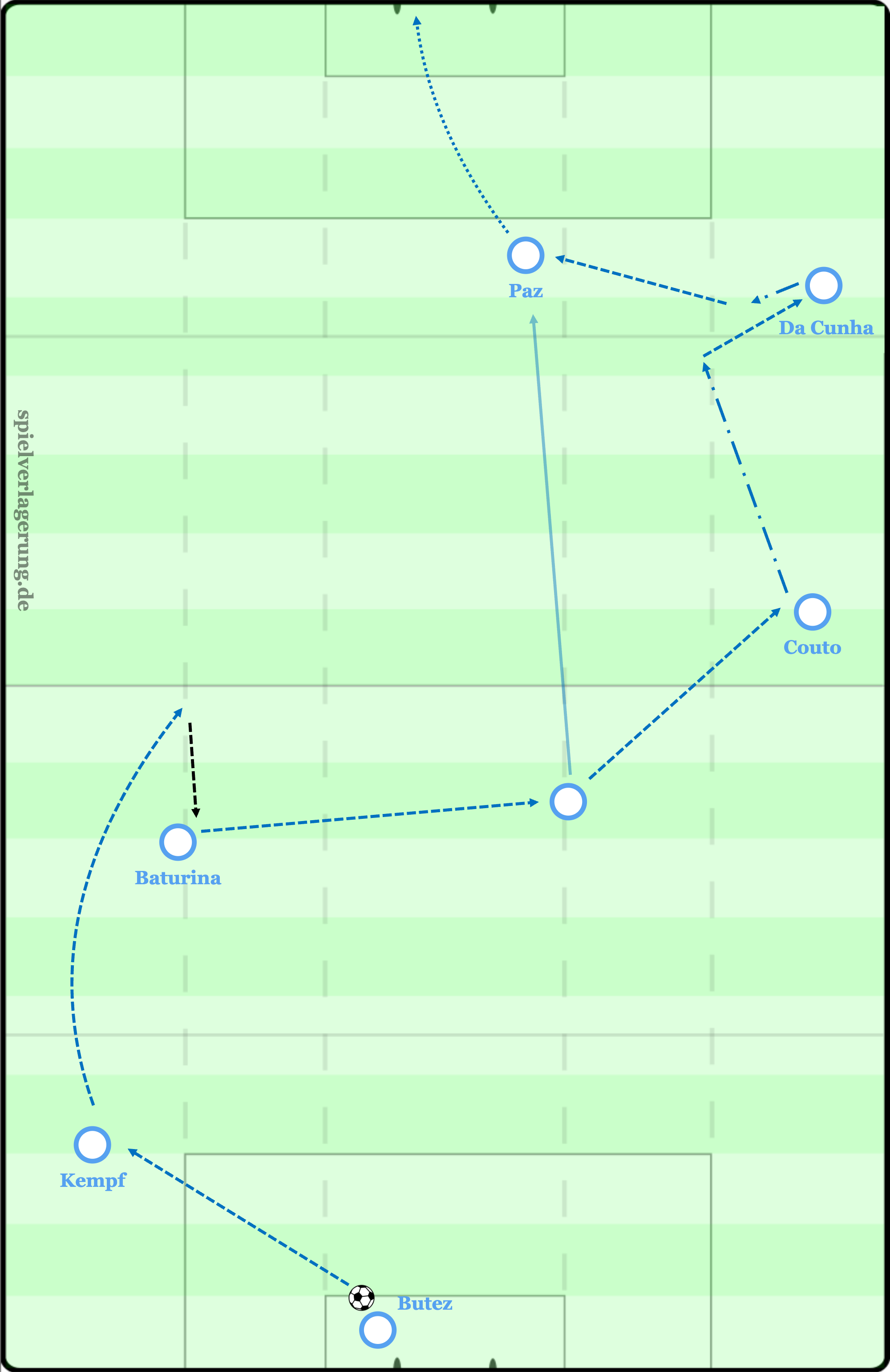
Close to their own goal, Como consistently involved goalkeeper Butez as an additional central player in the build-up. That created a five-against-four against United’s front line — awkward on paper, more awkward still in execution, because Como didn’t use the overload to play through but to tie opponents in. From there, the same shape kept appearing on both the right and the left: centre-back, full-back, a player from the half-position in the eight space, and a six alongside. A diamond that wasn’t an end in itself but had a purpose: the diagonal route out.
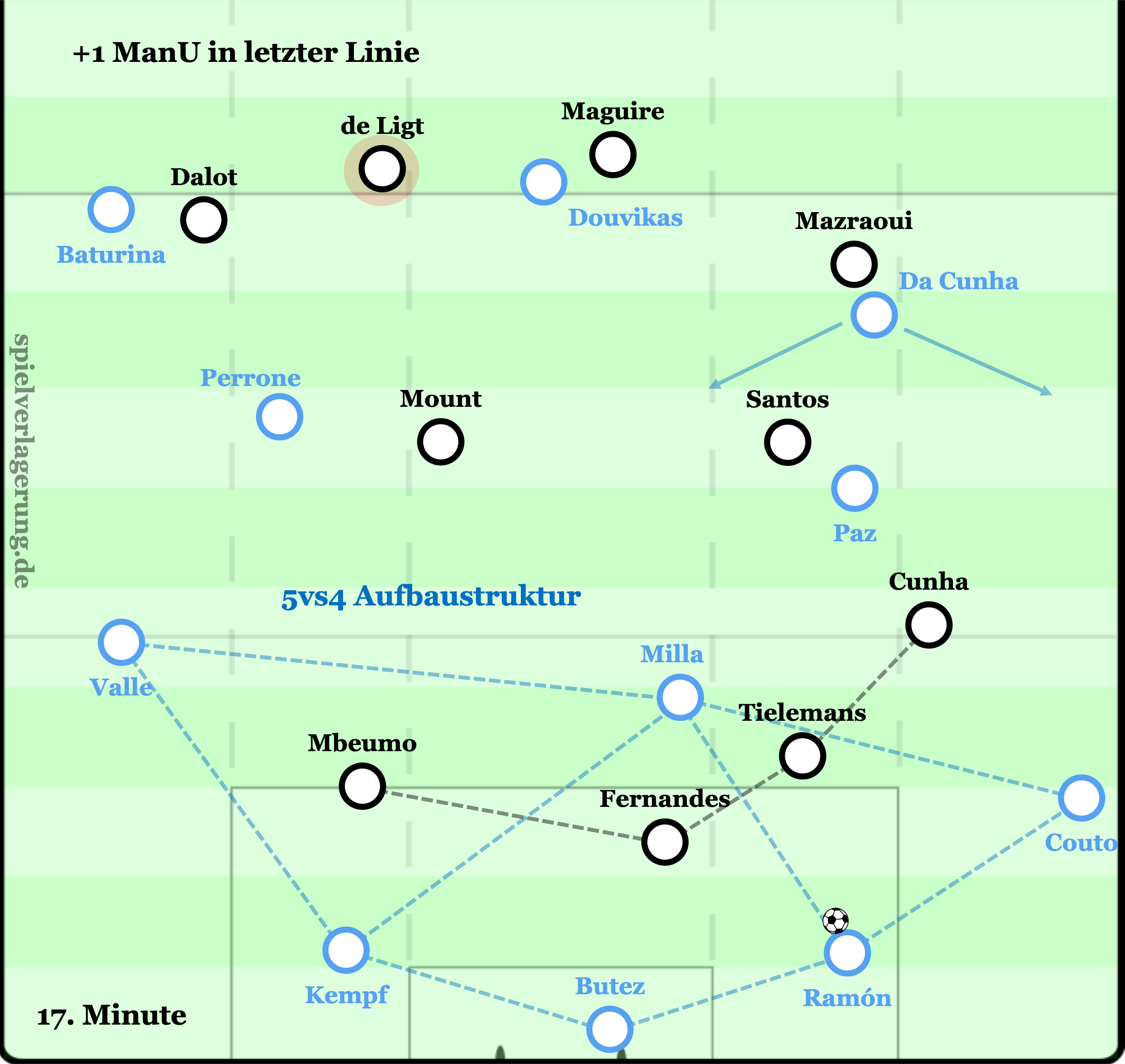
Como’s build-up structure. From a 4-1 (flat four), the half-positions with Paz and Perrone are added. Small triangles and diamonds emerge. The three attackers ahead of them create additional options in behind.
One detail deserves particular attention. At times the full-backs stood not wide but flat, in a half-position. That sounds like a nuance, but it had a clear function: it vacated the wing and created the space the eights could drop into — Paz and Perrone did so regularly. If you don’t occupy the wing yourself, you force the opponent to guard it anyway.
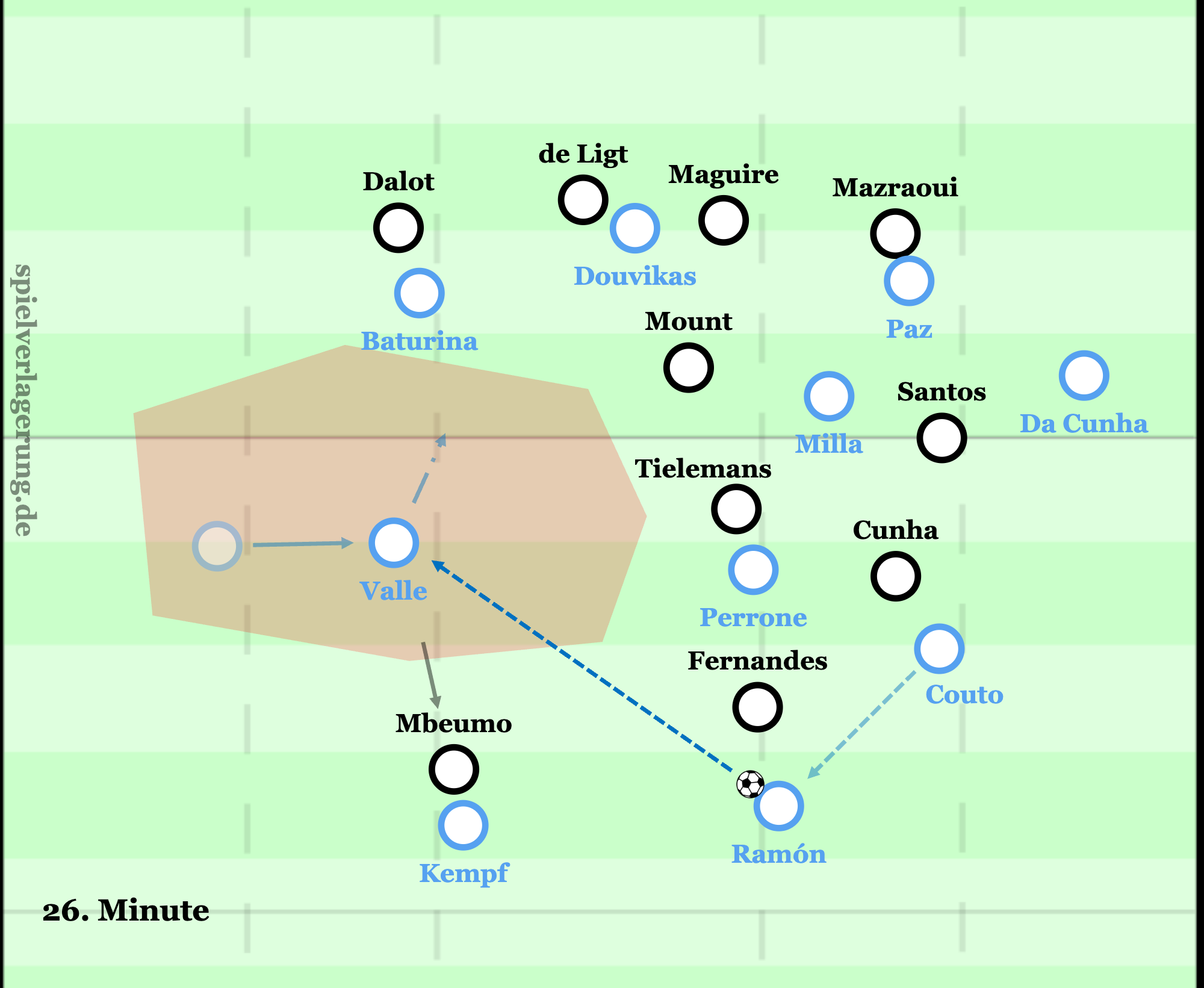
ManU got no access near the ball and left large diagonal spaces open on the far side.
For United’s midfielders this was close to unsolvable. Tielemans, Mount and Andrey Santos spent the whole game struggling to establish any responsibility at all, let alone get into duels. When an eight dropped out, they couldn’t follow, and if one of them was tied in by it, a two-against-one opened up on the far wing. Como didn’t create that situation once; they created it serially.
The decisive mechanism lay in receiving and relaying the ball. The player in the deeper position usually worked with two touches: the first took the ball backwards, the second relayed it to the free teammate. At the end of every one of those actions stood a player with the game in front of him — and from that open position he could switch play.
What made it possible were the preparatory movements. Paz and captain Da Cunha first lured their markers in the wrong direction and then worked with the head start they’d bought. That head start isn’t only space, it’s above all time: time to control the ball first and relay it second, rather than having to do both in one touch.
A scene in the 17th minute is typical. Mason Mount steps out, Mazraoui goes into the duel at the same time — nominally United are in an overload here. Only neither of them really gets to the opponent, because both are too late. Paz can therefore calmly take his touch backwards and switch play directly with the second, dissolving the pressure before it had even formed.
When the build-up ran down the right, it showed in a recurring pattern: Paz and Da Cunha took the first touch backwards or inside and then switched with the left foot out of a closed body position. The players they found were systematically in open positions — Milla, the far-side six, or the wing-to-wing connection directly.
In the second half, Como adjusted the shape and more often played with two sixes, to form the diamonds faster and switch to the far-side six faster. Couto stood out in this: the right-back repeatedly played the chip into the six or ten space — six or seven times in a row during one spell. It was mainly Paz who received the ball there and could launch the attack.
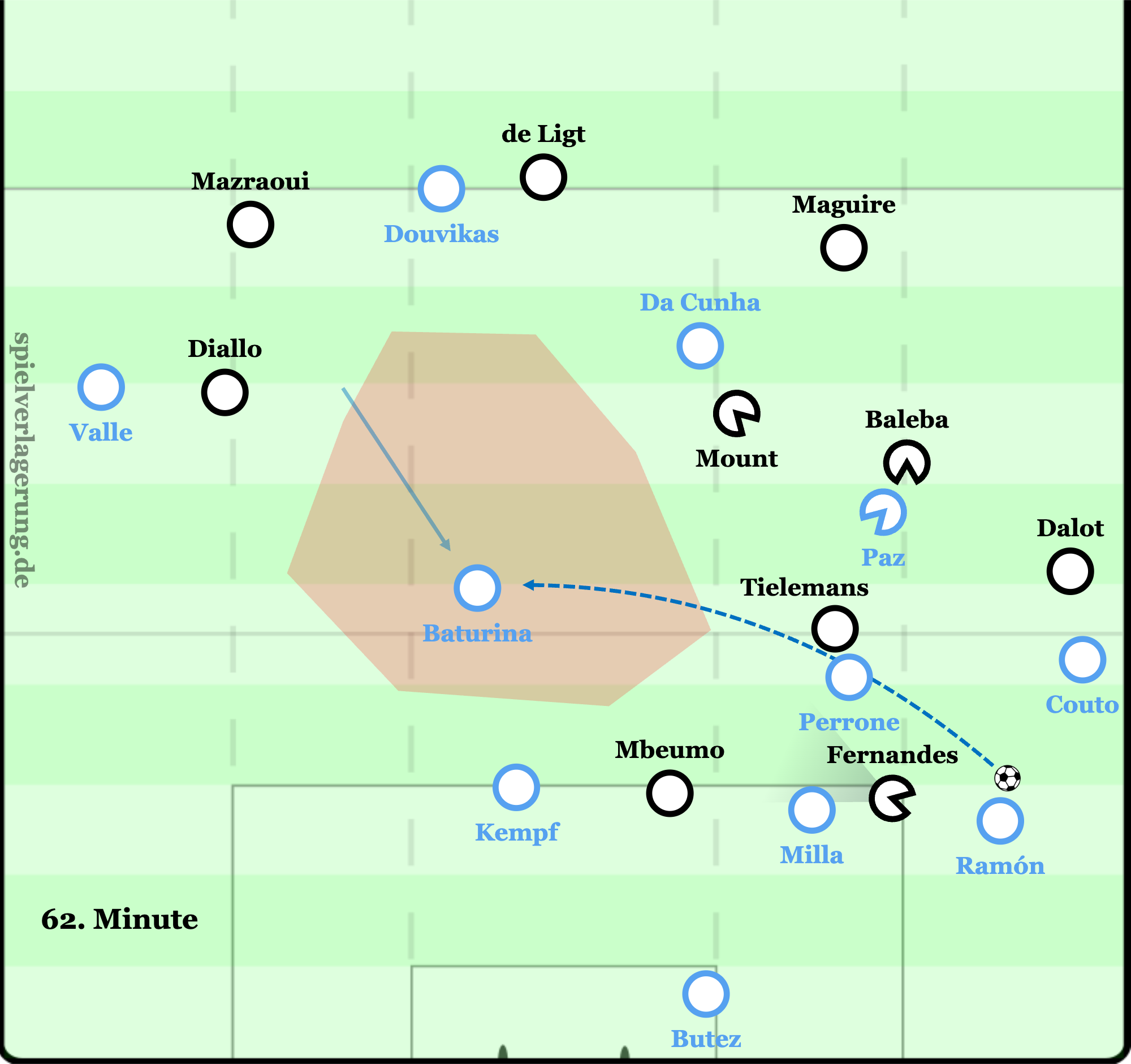
In the second half Como focus on those diagonal spaces and look for them mainly with chipped balls.
Especially striking inside the diamond are the rotations between the players. Because of the connections between them, they moved in rotation depending on running path, space and ball movement. The same recurring spaces were re-occupied. Under pressure on the ball carrier, the outer players pushed flat or ran in behind the opponents; the highest player in the diamond burst out of the cover shadow and became the reference point in depth. On a deep pass, the two wide players released and joined the depth, able to offer themselves again immediately in an open body position. If the pass went via the flat wide players, the spaces in front of the new ball carrier could be run into. Every rotation, every positional adjustment was coordinated with the others and, in the end, produced a stream of pressure-resolving passes while Manchester United chased the press in vain.
Transition and final third: the Z into the opponent’s back
Como bridged the middle third exceptionally quickly, via dribbles at speed and diagonal passes. Behind it stood a recognisable principle: first tie the opponent to one wing, then get behind them via the diagonal, and in the final third do the same thing again. In sum, that produced the shape of a Z — build-up on the right, transition on the left, finish from the right again.
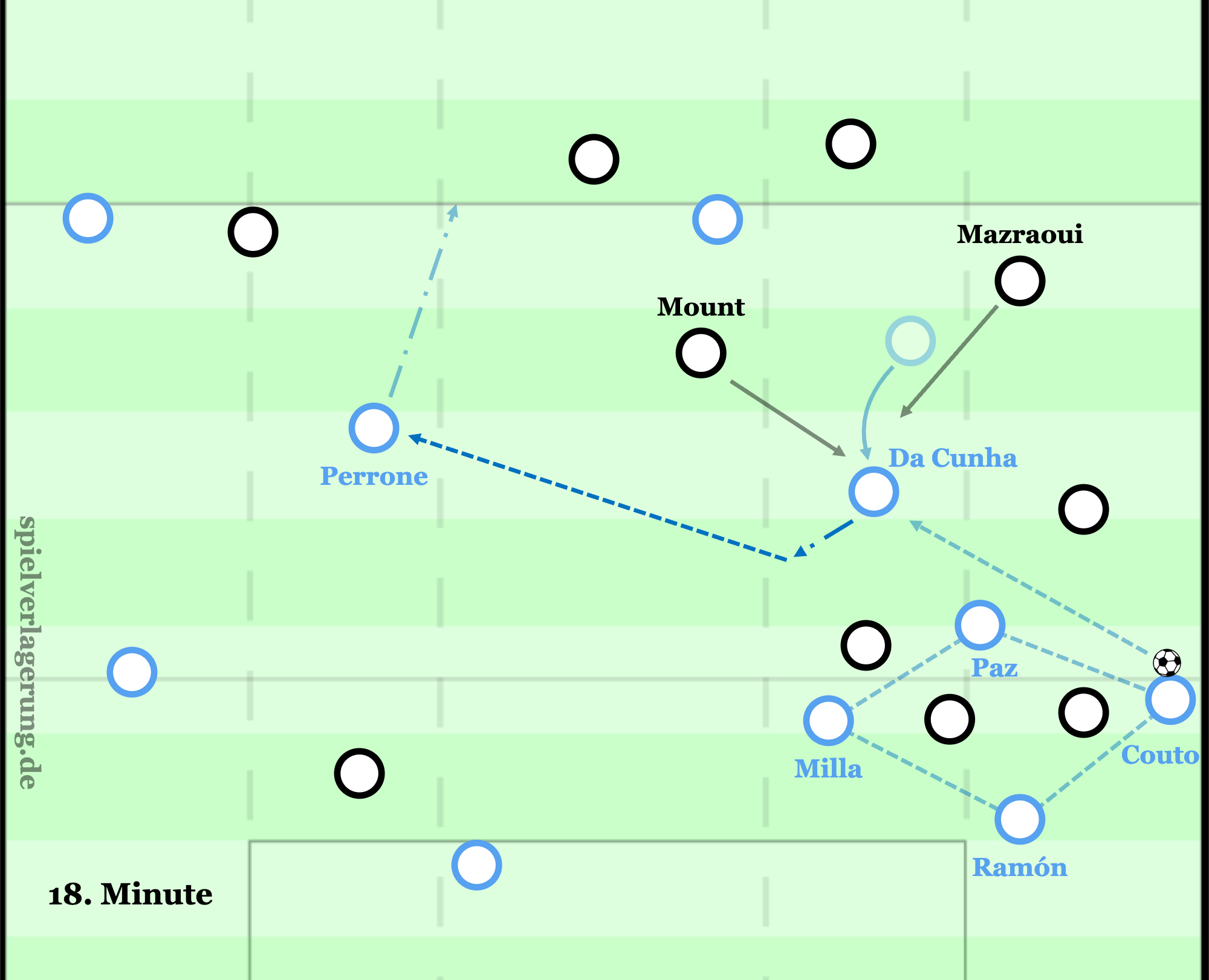
In this example Como pin ManU in the press with their short passing. Thanks to the extra attacker on the ball-near side they can play through the pressure and switch.
The connections between wingers and striker carried these attacks and were deliberately kept flexible. The wide players sometimes stayed wide, sometimes came short, sometimes tucked inside. Douvikas accordingly either waited deep in front of the line for the chipped ball or, when space opened up on the wing, received the deeper pass and then ran in behind along the wing as soon as the ball sat on the full-back’s open foot. That flexibility produced the overloads on one side, and the overloads produced the central overload.
In the final third one element was added that is rare in fast transition teams: patience. Como drew opponents towards them with dribbles and short passes, used back-passes when needed, and then switched in front of the block. Da Cunha, Baturina and Paz were the three who could tie opponents in and then find the diagonal. They created the positions on the diagonal, were available to receive, and used their space to apply pressure. The block was usually tied in with short touches, the switch and the position behind the opponent prepared, and quick finishes sought.
The intensity in possession shouldn’t be underestimated. Practically every attack involved at least three or four players, the width was occupied, the centre likewise, and there were multiple options throughout. What they looked for almost every time was the space behind the opponent on the far side — exactly the zone that is closed last when a block shifts across.
Paz brought the right profile for this pattern. A strong left foot cutting inside from the right, he repeatedly dropped into the right-hand blind side of his opponents, got shots away there with few touches, and racked up the most shots of the match. That the finishes generally came off few touches isn’t a detail but the consequence of the time won further back.
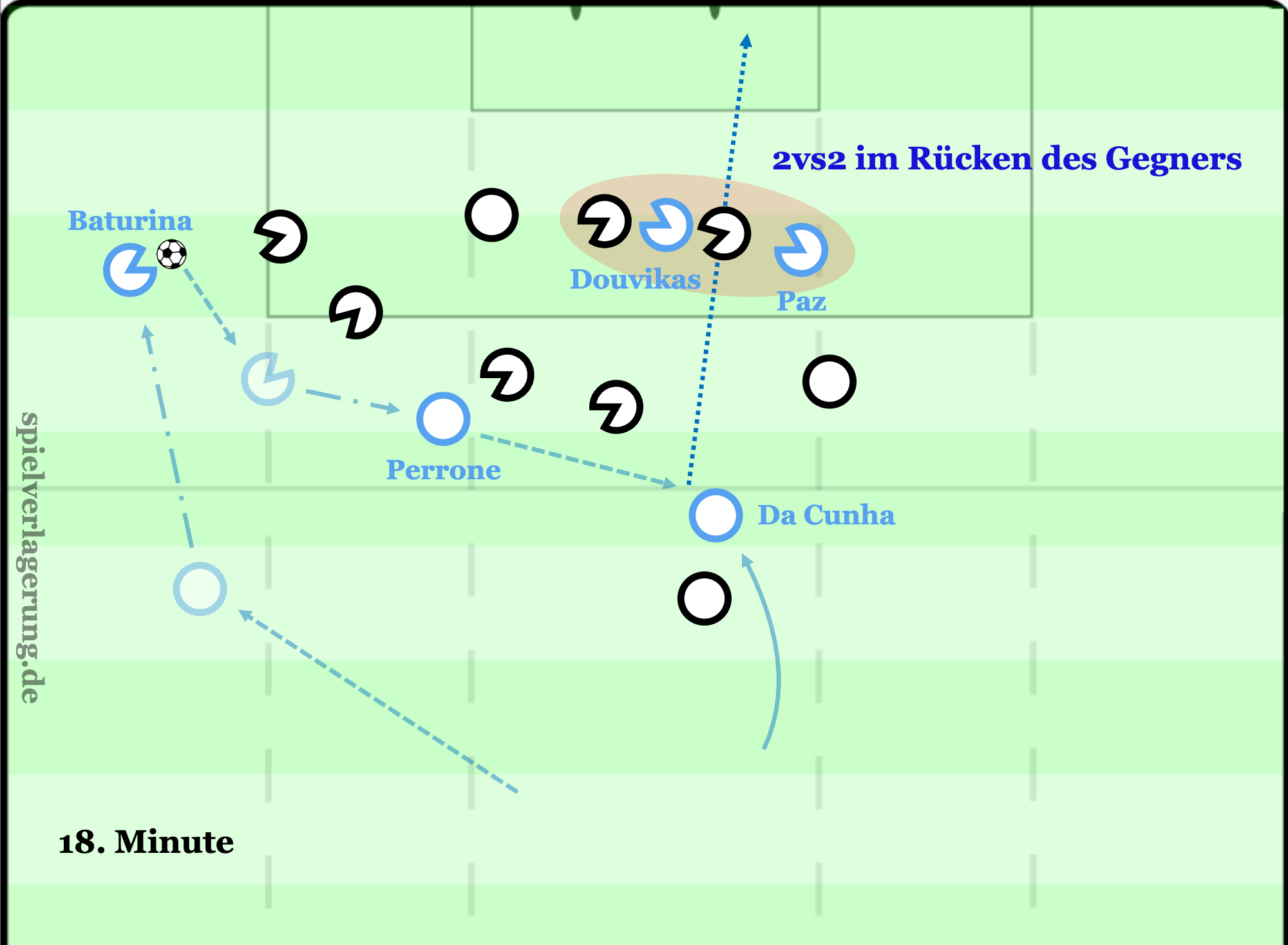
As the move continues, Como again look for the blind side of the defenders. Here Douvikas and Paz are positioned in behind, with Da Cunha joining in front of the back line. After briefly pinning the opponents, the switch reaches Da Cunha, who misses the target from distance.
What carries all of this is the technical execution. Soft passes, sharp ones when the moment called for it, consistently well timed and played into the right foot — for ninety minutes. Passing that secure at that tempo is what makes a variable concept actually retrievable.
Why United never got into the duels
United’s basic problem out of possession was the hybrid. They pressed half man-oriented, but with a plus-one in the last line — a construction that forces compromises in both directions. It demands access up front that it doesn’t fund at the back.
There were certainly moments when it worked. When Dalot pushed through into the press on the right and passed his man backwards, a clean man-orientation emerged all the way up to the front — and with it a clear assignment for Mount, out of which the ball could be won. But that stayed the exception. Most of the time Dalot sat too flat out of possession, so United couldn’t trigger the duels up front and went into the press a man short.
Mount was the most conspicuous case in this respect. He barely got into a duel across the whole match because the decision to step out always came too late. Against a team that works with preparatory movements, a late decision is practically the same as none: the opponent already has the head start before the journey even begins.
On top of that came a problem on the far side. There, United’s winger frequently failed to protect the depth — usually Mbeumo, who jogged back rather than closing the space. But that was precisely the target zone of Como’s diagonal switches. It allowed them to change sides almost at will and regularly find an open structure on the other side.
The second half brought no improvement. The distances to opponents stayed large, and centrally what was actually intended still didn’t materialise. Michael Carrick’s double change at half-time was meant to bring more physicality to the six with Carlos Baleba, but it didn’t solve the problem — the assignments still didn’t work, the duels in the centre still didn’t happen, and the wide positions dragged the eights out further, which opened new spaces.
In the end the energy simply wasn’t there to press with the necessary intensity. United’s press became increasingly static, and a static press against an opponent with this passing quality yields not a single ball win — it only hands them the starting positions they’re looking for anyway.
Como’s press: steering and isolating
Como started the game in a high press and sustained it above all in the first half, with isolated spells after the break too. It was triggered on back-passes and goal kicks — and, remarkably, by their own goals: after every strike the team immediately pushed high again instead of managing the lead in a deeper block.
The steering ran consistently towards United’s left build-up side. The reason is personnel: Harry Maguire played there with his weaker left foot as the outside foot, and next to him stood another right-footer in Noussair Mazraoui on the left. Two right-footers on one build-up side means the ball always has to be taken back inside to play on — exactly where Como were closing the door. The press was usually triggered by the left-sided forward, with the ball ending up at either Maguire or Mazraoui.
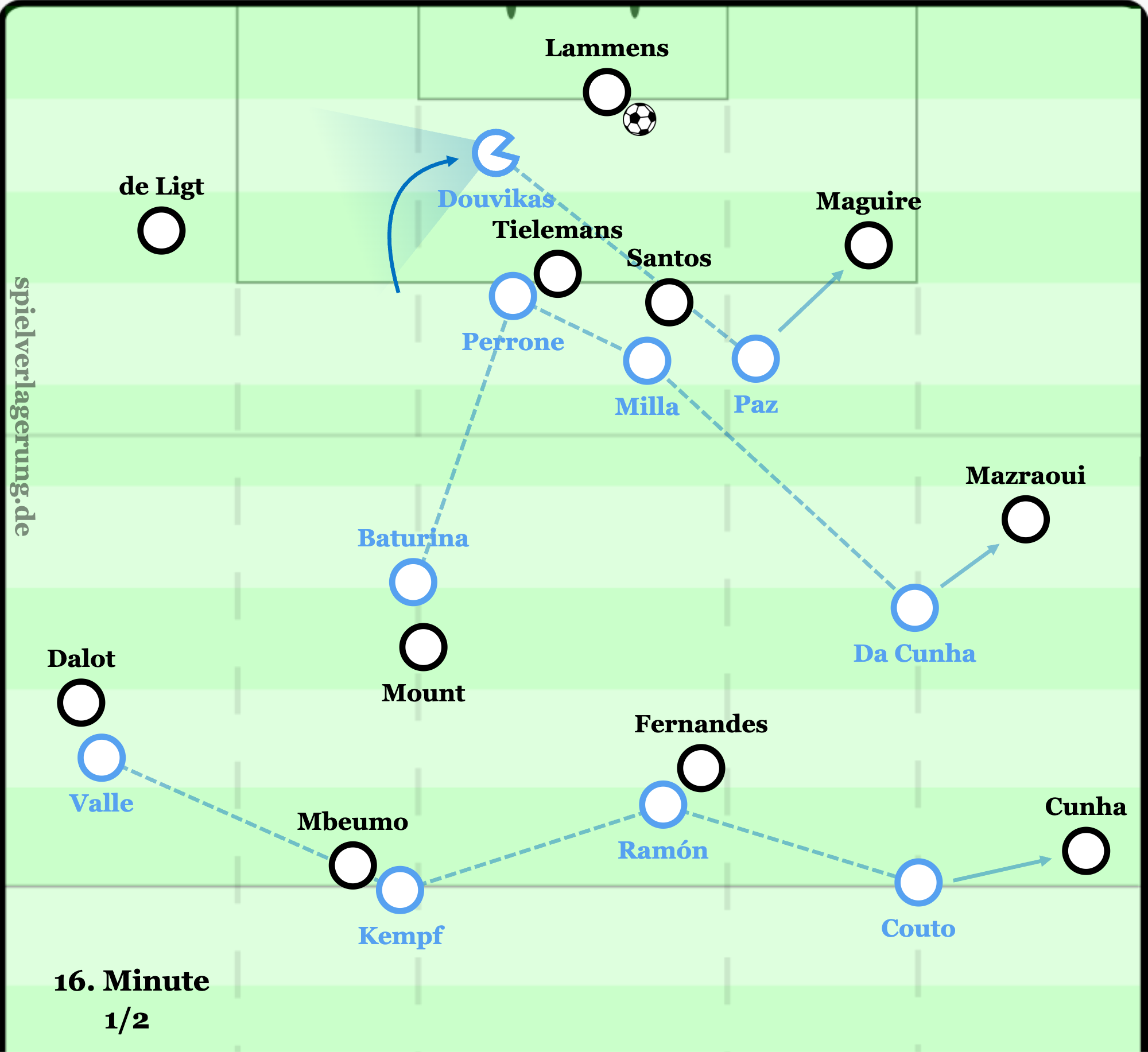
Pressing structure after the change in the second half.
In the centre Como defended man-oriented, with both sixes pushing very high and taking flat passes into United’s midfielders out of the game. That removed the short route through the middle as an option and left the long ball. But the long ball triggered nothing for United: the second balls went to Como practically every time.
That isn’t chance, it’s running work. The sixes consistently tracked the negative pressing paths back, anticipated the long ball early, and were in front of the line before it arrived. Luis Milla covered the most ground of any player on the pitch in this pattern — recovery runs after being played past, doubling up on the ball, attacking the second ball. When the long ball came from Maguire or one of the full-backs, a six was regularly in front of the line with an intense sprint, sealing the centre, taking away the diagonal follow-up passes and attacking the loose balls.
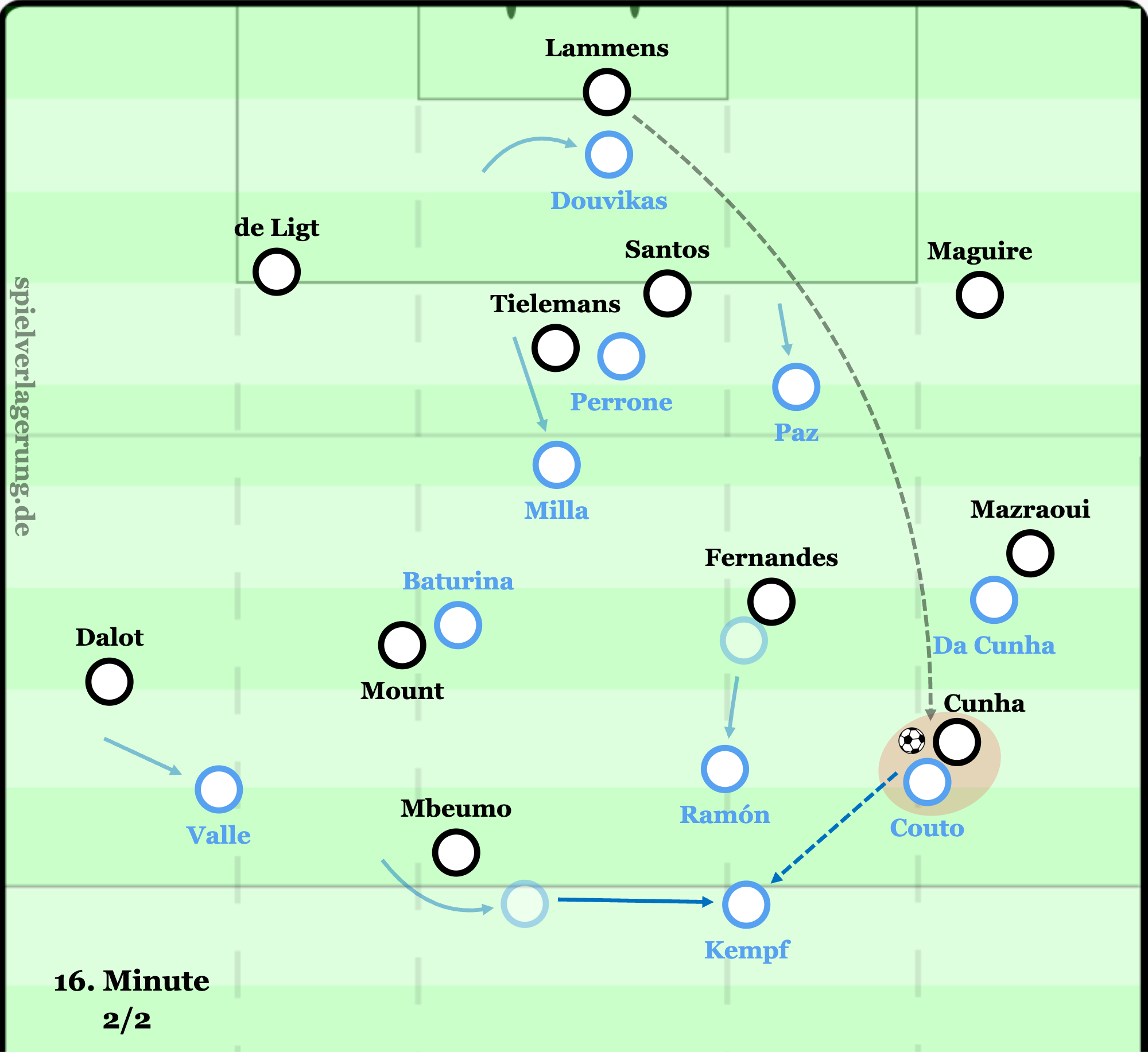
Defending the long ball and extra support on the second ball.
Once the ball was on one side, that side was isolated. The near-side forward had access to the centre-back and dropped back a touch when the pass went to the full-back, so that he covered centre-back and six simultaneously and closed the square pass. The far-side forward marked the goalkeeper. That served two functions at once: it took away United’s escape route via the keeper along with the switch, and it kept a player in position for the moment of the turnover.
The double pivot worked in a deliberate half-position. The near-side six stayed tight to his man, the far-side one dropped slightly behind him — securing the space and at the same time establishing access to the far-side centre-back in United’s back three.
The last line defended largely man-for-man in the high press, and very tightly. But the decisive detail is the one that carries the whole concept: the man-marking near the ball applied only to the action in progress. Around it, players were already releasing from their assignments and orienting towards the second ball. That is only retrievable at very high intensity — and it’s the reason United’s forced long balls produced not a single usable moment.
Midfield press: the half-position and the half-time adjustment
When Como dropped a line, the man-orientation at the second height stayed exceptionally high. Here too the back-pass served as the trigger to push up as a unit and tip back into man-marking. If United were in a closed body position, the Comaschi had already pushed up far enough to attack the back-pass at the moment it was played — a pattern that led directly to the 3-0. The half-position was at work there again: closing down level with the centre-back while simultaneously prepared to push through onto the next player deeper.
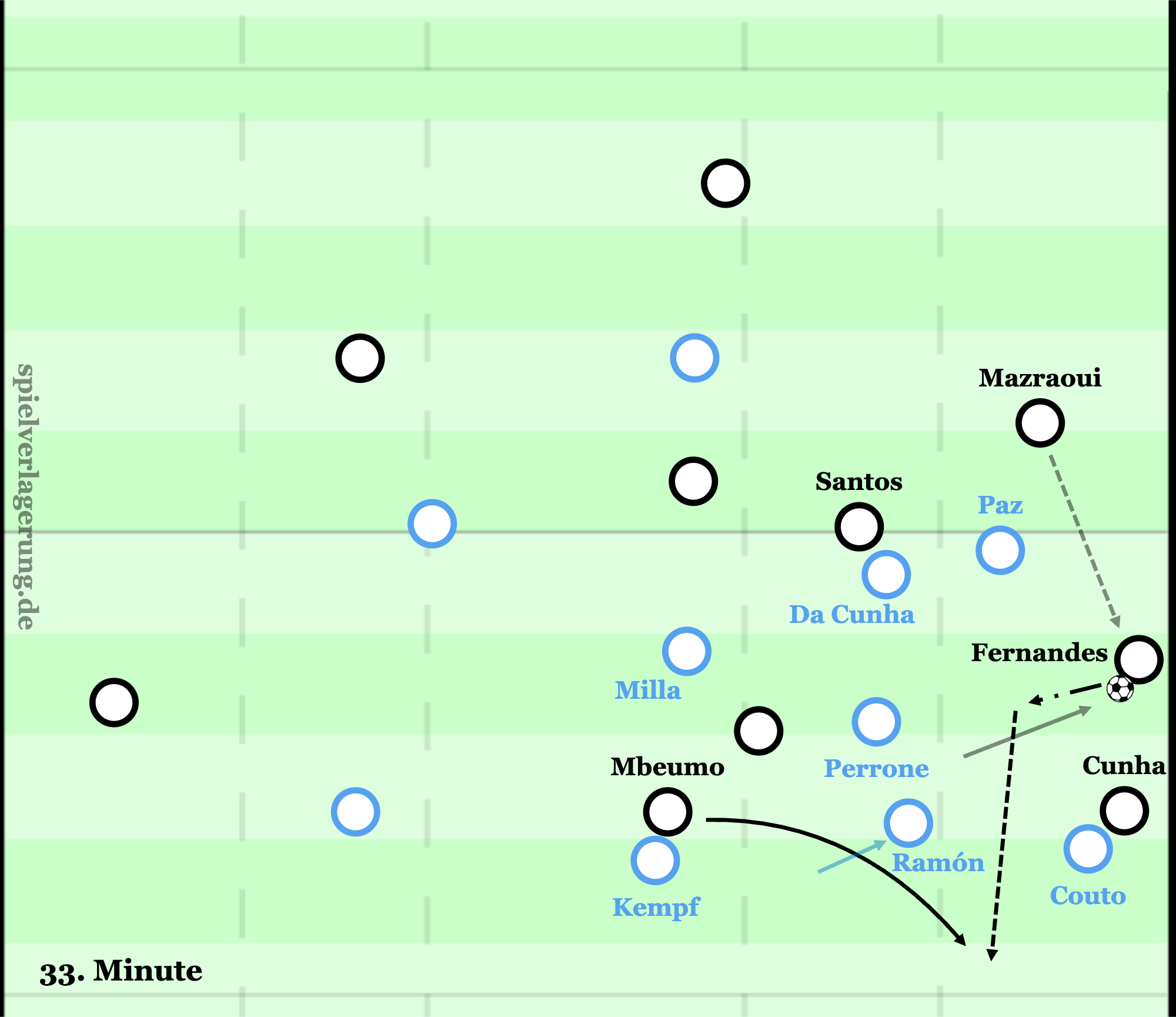
In the first half Como still had problems assigning the half-positions against ManU’s 3-2-5. In this example Fernandes moves to the wing, Como fail to establish responsibility and access and are played through at mid-height.
Up to half-time, though, Como had a structural problem with this. The pure man-marking didn’t come off cleanly, because of the two sixes in front of the line, one should really have tucked in and taken over the half-position for the centre-backs. That didn’t happen consistently. The consequence: a centre-back stepped out, the space behind him stayed unoccupied, and that was exactly what United kept attacking.
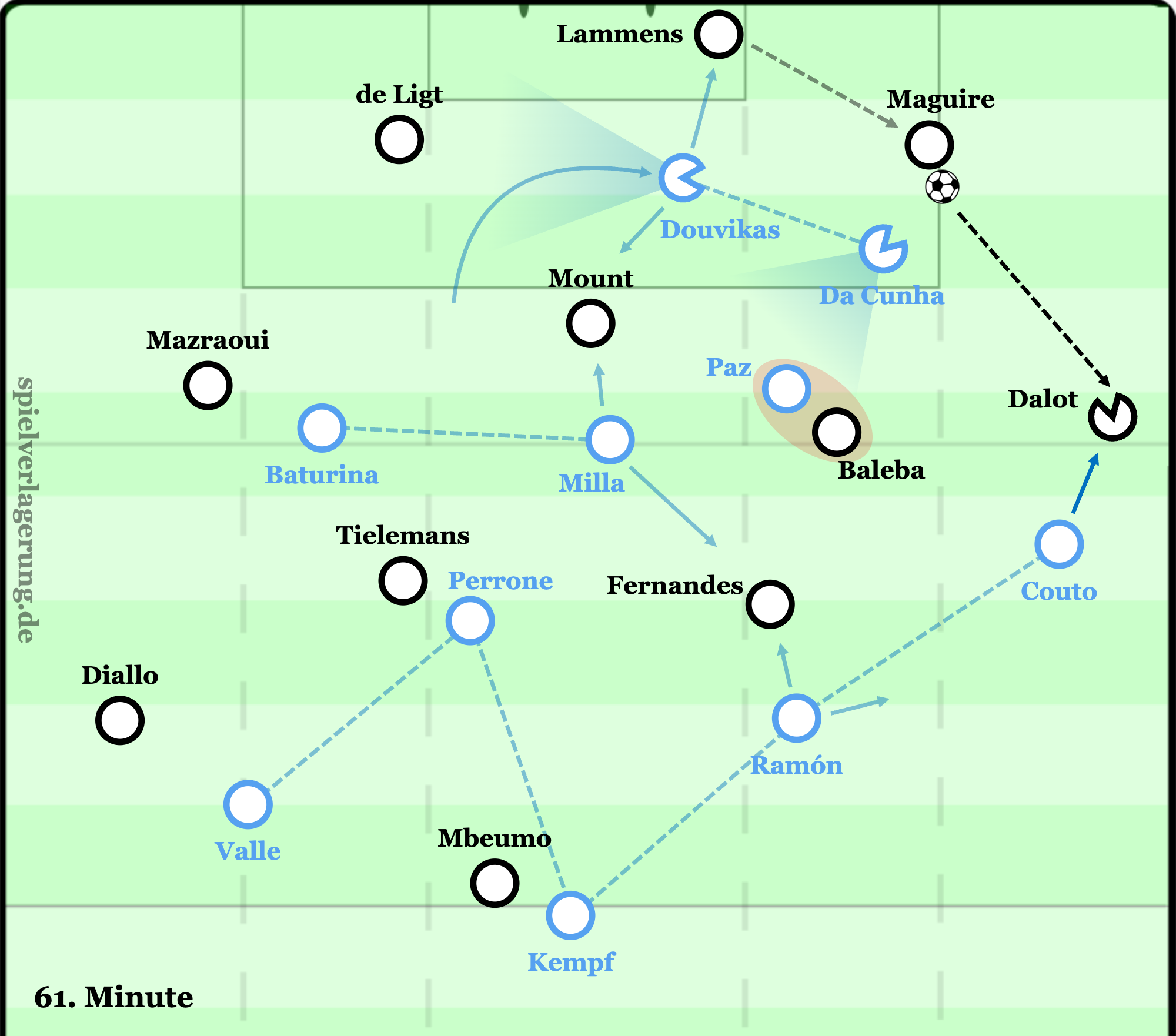
The pattern of pressing onto Manchester United’s left side continued in the second half, now with Dalot at full-back. The press was still triggered by Douvikas, with the ball-near winger pushing up as a second striker to press the centre-back. Paz focused on the visitors’ ball-near six and Couto pushed through onto Dalot. Through the central connections the game was isolated on one side.
At half-time Como adjusted. One six moved directly into the line, with the far-side winger pushing in onto the six — they now pressed out of a 5-2-1-2. Lucas Da Cunha pressed through from the right onto Maguire, while Nico Paz picked up United’s six. The central forward pressed the central centre-back and from there carried on to the goalkeeper. The far-side wide midfielder and the remaining six were poised — one onto United’s free six, one onto the far-side centre-back — again in that half-position between opponent and the space to be protected.
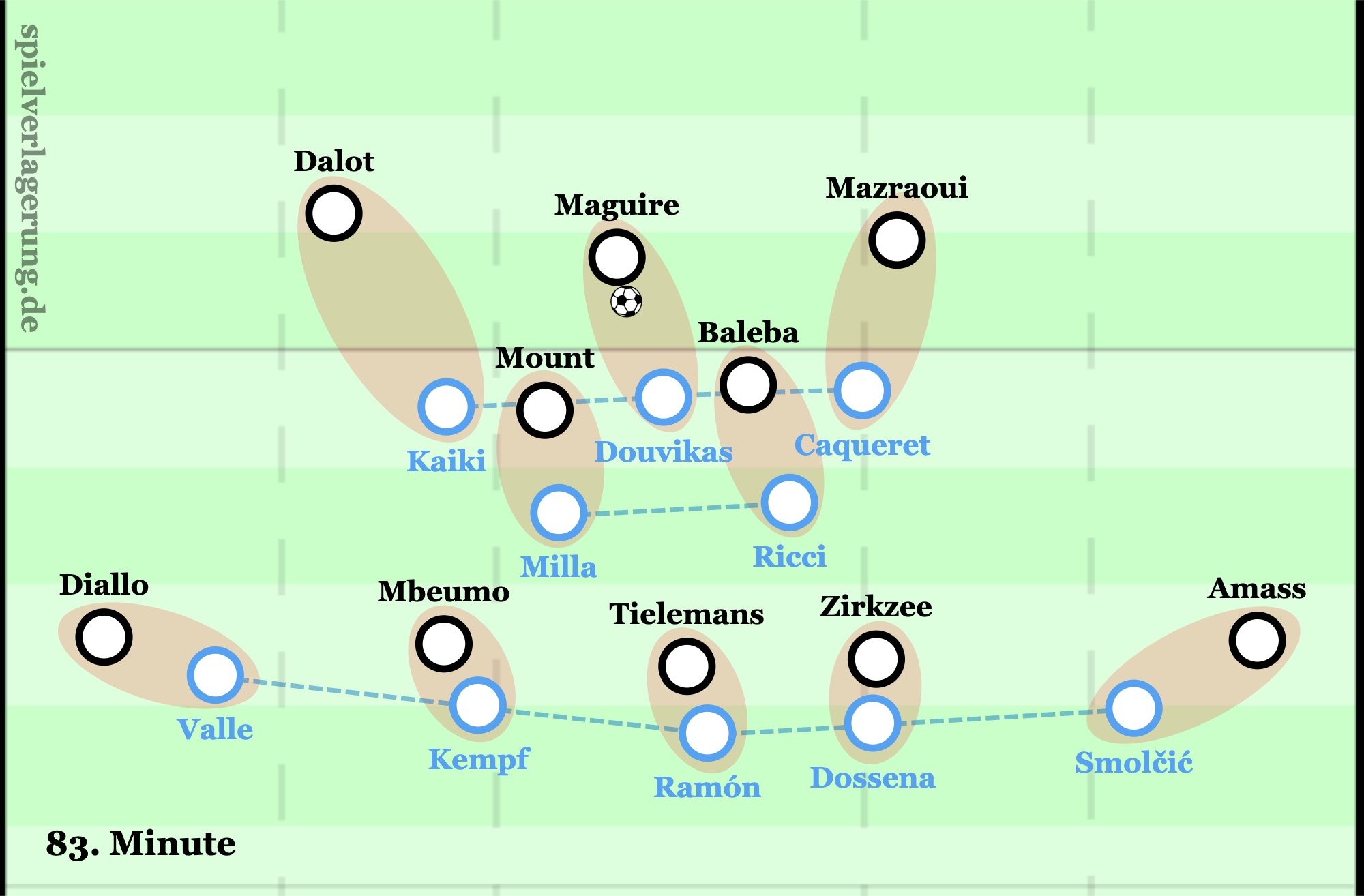
ManU building up high against the man-oriented Italians.
The effect was immediately visible. Como controlled the half-positions, got access right into the last line throughout, and set the rhythm of the match from then on. The adjustment solved exactly the problem the first half had left open, without changing the underlying principle.
Deep defending: box packed, long shot on offer
In the final phase Como defended from a very deep line inside the box. That left barely any space behind the line to play into — which United hardly looked for anyway. The visitors attacked little depth and rarely occupied the width in the final third, so Como could stay compact without being punished for it.
Accordingly, a lot of players stood very centrally in and in front of the box. That produced numerous cover shadows and a numerical superiority around the ball, which allowed them to steer actively within the block rather than merely react. At times they deliberately steered inside, to guide the opponent into the prepared congestion and cover from a deeper position.
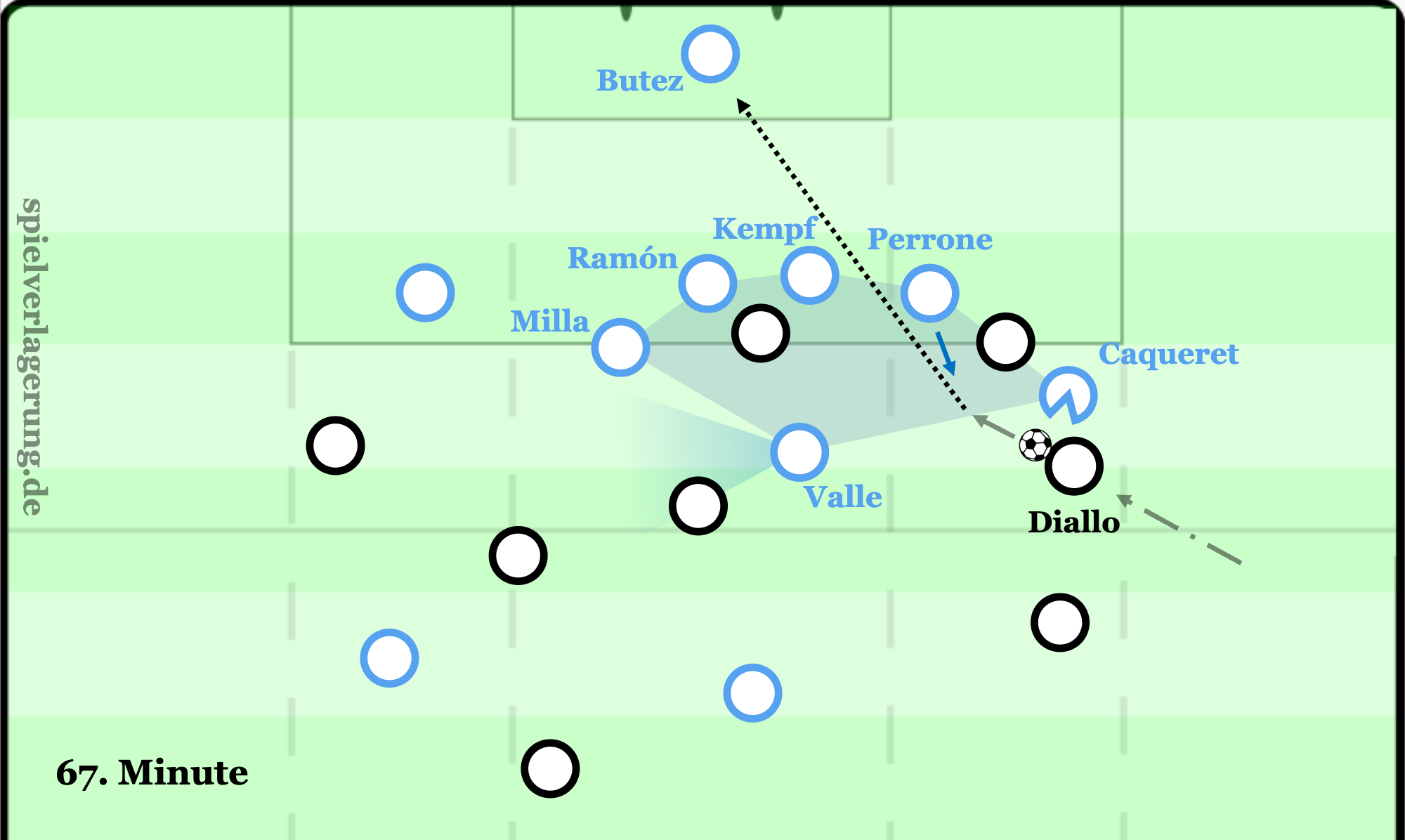
Deep back line in the box, centre closed and play steered inside. The box defending allowed the English side shots from distance.
The crucial point is that Como left the gaps open not despite this set-up but because of it. If you pack the box and secure the depth, you give up the space in front of the line — and that is exactly where United were supposed to shoot from.
The numbers vindicate the decision. Taking the conceded goal out of the box, Como allowed nine shots from outside the penalty area across ninety minutes, worth roughly 0.24 xG combined; only three of them were even on target. On top of that, of the four shots inside the box, two came from at least 14 to 15 metres and effectively belong in the long-range category as well. United accepted the invitation, and the shooting quality was perfectly decent — it’s just that with that scoring probability over a whole match, the most likely outcome is precisely what happened.
The goals
Tracking the ball for the first goal.
1-0, Nico Paz (2′) — The goal comes before United are even set. Como take the goal kick quickly and play straight to the full-back, luring the visitors into the press — only not cleanly. Mason Mount triggers the pressure and is played past, and on the second ball he goes into the duel as well instead of holding the middle and looking for the space where he could pick the ball up. That is exactly what opens the centre, the space for the second ball is there, and Paz can play it through.
What follows is the transition principle in its purest form: a quick switch to the diagonal side, then short passes against a very deep line. Matheus Cunha doesn’t pick up the player behind him and leaves the ten space open, where Paz is standing. He needs two touches because neither Cunha from above nor Maguire from his distance gets into the duel. Lammens, for his part, doesn’t defend the goal with his cover shadow but takes the near post — which leaves the far corner to a strong left foot. The curled finish into it is quality, though.
2-0, Anastasios Douvikas (49′, assist Paz) — Same zone, same cause. Bryan Mbeumo doesn’t choose to shut the centre but closes the centre-back, which creates the space for Da Cunha, who drives forward and plays Martin Baturina in. Centrally, Mount again fails to pick up his man. Out wide, Amad Diallo, introduced at half-time, generates no pressure centrally, so Mazraoui can’t take over the deep wide player in the first place.
The result is Paz behind the opponent, in the ten space, dribbling unopposed at goal. Matthijs de Ligt establishes no reference to Douvikas’s run in behind and slips as well — a one-against-one with the goalkeeper that Douvikas finishes coolly.
3-0, Nico Paz (57′) — The only goal that comes directly out of the work against the ball. Como are in the midfield press in a closed position with access to the inside lane, win the ball there and punish a lapse of concentration in the visitors’ build-up. At the end, Paz is alone in front of Lammens again.
4-0, Jacobo Ramón (76′, assist Kaiki) — This goal comes from a longer possession spell and shows the assignment problem in its clearest form. Mazraoui is too narrow and has no access to the wide player. Diallo stands in the space with access to neither the central player nor the full-back nor the winger — an orientation that doesn’t work in any direction.
Como switch to Máximo Perrone, who can slide the ball out wide because the space is simply free. From there comes the cross from an open body position, and in the centre Como run a two-against-one at the end of which Ramón scores.
4-1, Joshua Zirkzee (90′) — Como’s only lapse, and one in a phase in which the team had already dropped very deep. United get the ball to the wing, it’s two against two in the box, and the cross is initially only feinted. Zirkzee orients himself well forwards at that moment, while Como’s defenders are already stepping out after the feinted cross. Diallo’s ball in behind the line is strong, the offside call is razor-thin in his favour, and Zirkzee takes two touches before finishing one-against-one with the goalkeeper. A blemish, not a structural problem.
The common denominator — Three of Como’s four goals come in the same zone: the space in front of and behind United’s line that nobody takes responsibility for. Mount is involved in two of those scenes through an assignment he never establishes, Diallo in two more after coming on. Nico Paz is at the heart of three of the four goals, twice as scorer, once as the provider — always out of the opponent’s blind side.
Conclusion
Como’s 4-1 has one common cause across every phase, and it lies less in any single idea than in its execution under continuous load. Out of possession they steered, isolated and speculated on the second ball — with man-marking that applied near the ball only for the action in progress and was already dissolved around it. In possession they tied opponents in, switched play and worked systematically into the space behind. Both require eleven players to anticipate a teammate’s decision, and both functioned over the full distance.
The connecting detail is the half-position. In the press, the far-side six stood between opponent and the space to be protected; in possession, the eights worked out of the same zone, and the full-backs occupied it flat in order to vacate the wing for exactly those players. Como, in other words, occupied the position in both directions from which two jobs can be done at once — which is why the side could neither be played past in the press nor be pinned in the build-up.
For United the diagnosis is more uncomfortable than the result. The problem wasn’t individual errors but that the team never, in any phase, got into the duels it needed. The mixture of half man-orientation and a plus-one in the last line funded no access up front, and without access every decision is made too late — from Mount in the centre to Mbeumo failing to secure the far-side depth. Carrick’s double change at half-time was meant to bring physicality to the six with Carlos Baleba, but it changed nothing about the assignments, and in Diallo a player came on wide who reached neither one opponent nor the other in his space. That the energy ran out in the end was a consequence rather than a cause.
That leaves the context. A 4-1 against Manchester United is no proof in itself, and Como’s finishing was exceptionally efficient on the night. What showed regardless of the result, though, is a team with a recognisable, rehearsed answer in all four phases of the game — and one that put a technical maturity on the pitch in possession that you wouldn’t readily credit to a side promoted two years ago.
Keine Kommentare vorhanden Alle anzeigen