
Aspect analysis: Leipzig never found a trigger – LC
A 6-1 reads like a game in which everything fell apart. Look at how the goals came about one by one and a different picture emerges: it was not six separate problems but two or three, which Bayern punished in seven variations. No pressure on the man in possession, marking problems in central areas, and a back line that did not work with the movements in front of it – that chain runs through practically every goal conceded.
This aspect analysis therefore takes the goals rather than the game as its material and works back from there to the patterns.
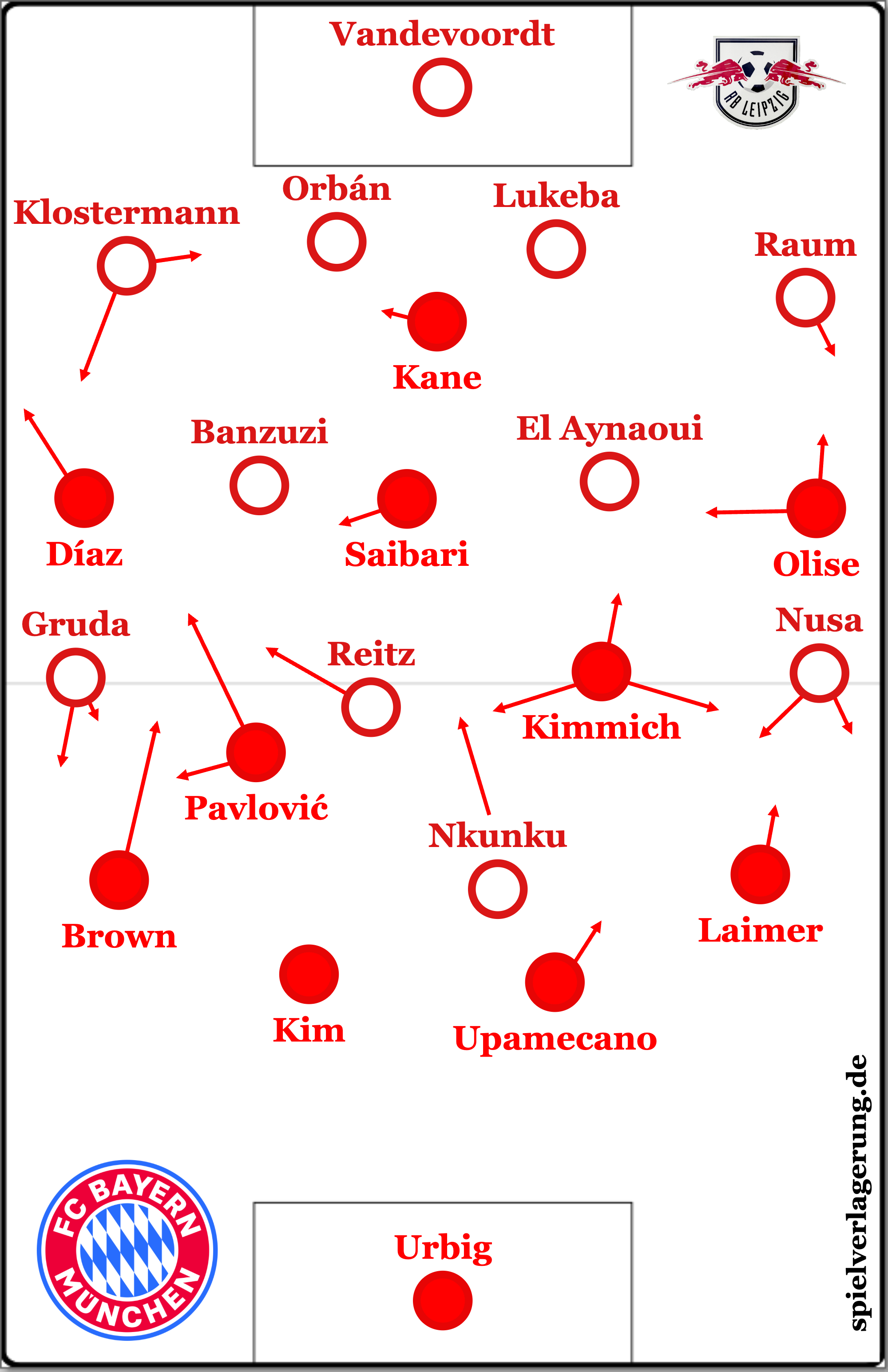
Pressing and build-up: where Leipzig lost access
Bayern triggered very high throughout, stayed tight to their opponents and pushed through centrally without hesitation. Vandevoordt was pressed from Bayern’s right, with the clear intention of keeping him away from the left-hand build-up route and forcing the long ball. Leipzig’s front line of Nusa and Brajan Gruda repeatedly angled their runs deep against Nathaniel Brown and Konrad Laimer.
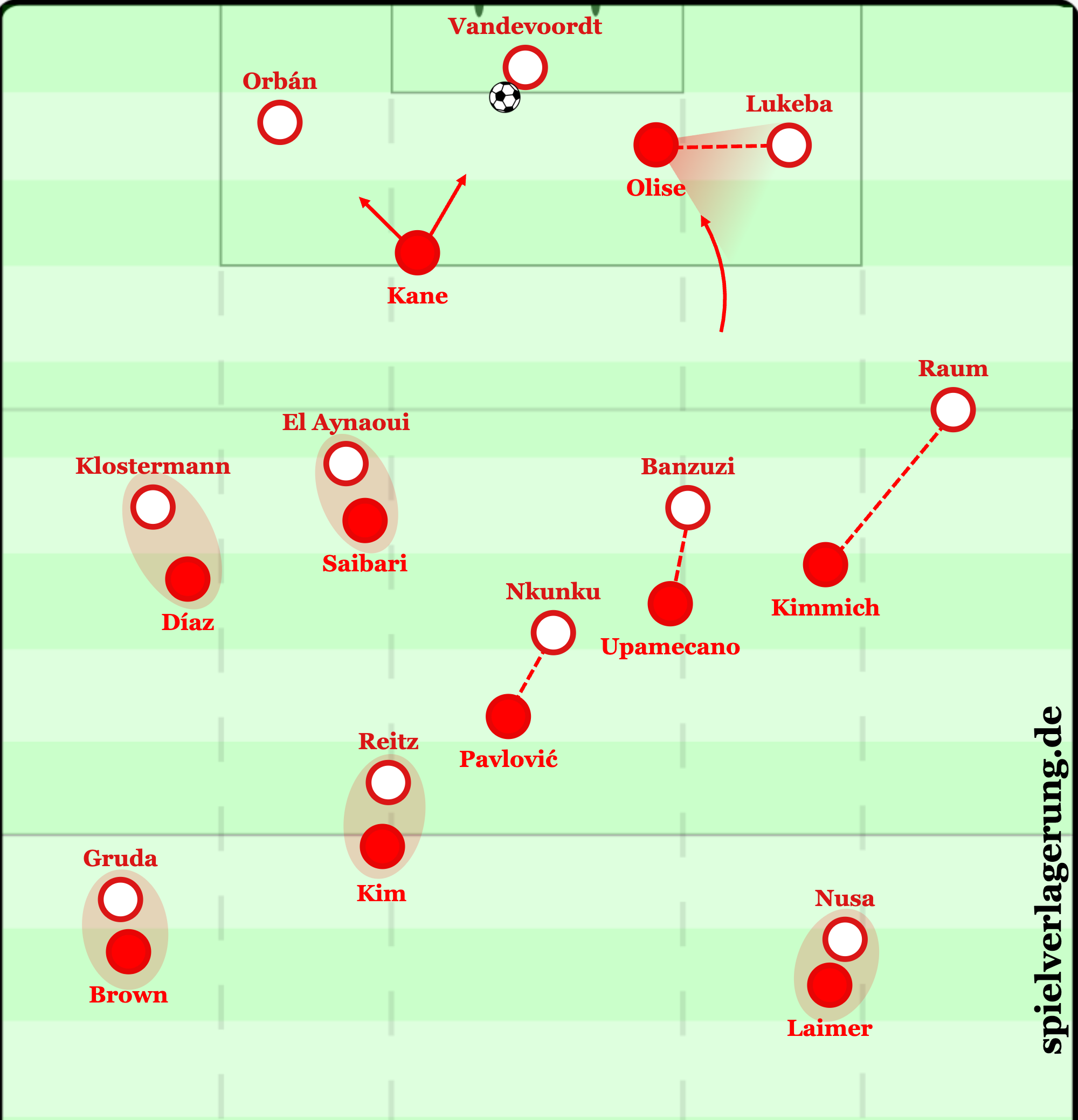
Bayern had one extra central player dropping into midfield in this phase, usually Kimmich. Had Leipzig played short to the right, he could have pressed through onto Raum; in practice he stayed central and pushed through from there. That left Leipzig with the long ball, and it was ineffective: it produced almost no regains, so the enforced forward play brought neither relief nor territory.
Going the other way, Leipzig got no access at all, and the reason was Bayern’s rotations. Kimmich dropped right, Pavlović left into a back three, with Upamecano holding a very wide position. Against this shifting three-man build-up Leipzig never found a trigger, because the assignments reset with every rotation – whoever was supposed to step out of midfield first had to work out who he was picking up. The handover of pressing duties out of central areas failed repeatedly.
In front of that, Bayern staggered their shape so that Leipzig’s compactness became the problem. Olise moved into the ten space at times, Nathaniel Brown operated in the half-lane and ran beyond from there, Luis Díaz stayed wide left. Saibari and Kane pinned several opponents centrally while regularly pulling out of the central lane. Because Leipzig pressed very narrow, this produced exactly what Bayern were looking for: once the opponent was committed near the ball, the switch followed, and on the now open side stood a one-on-one.
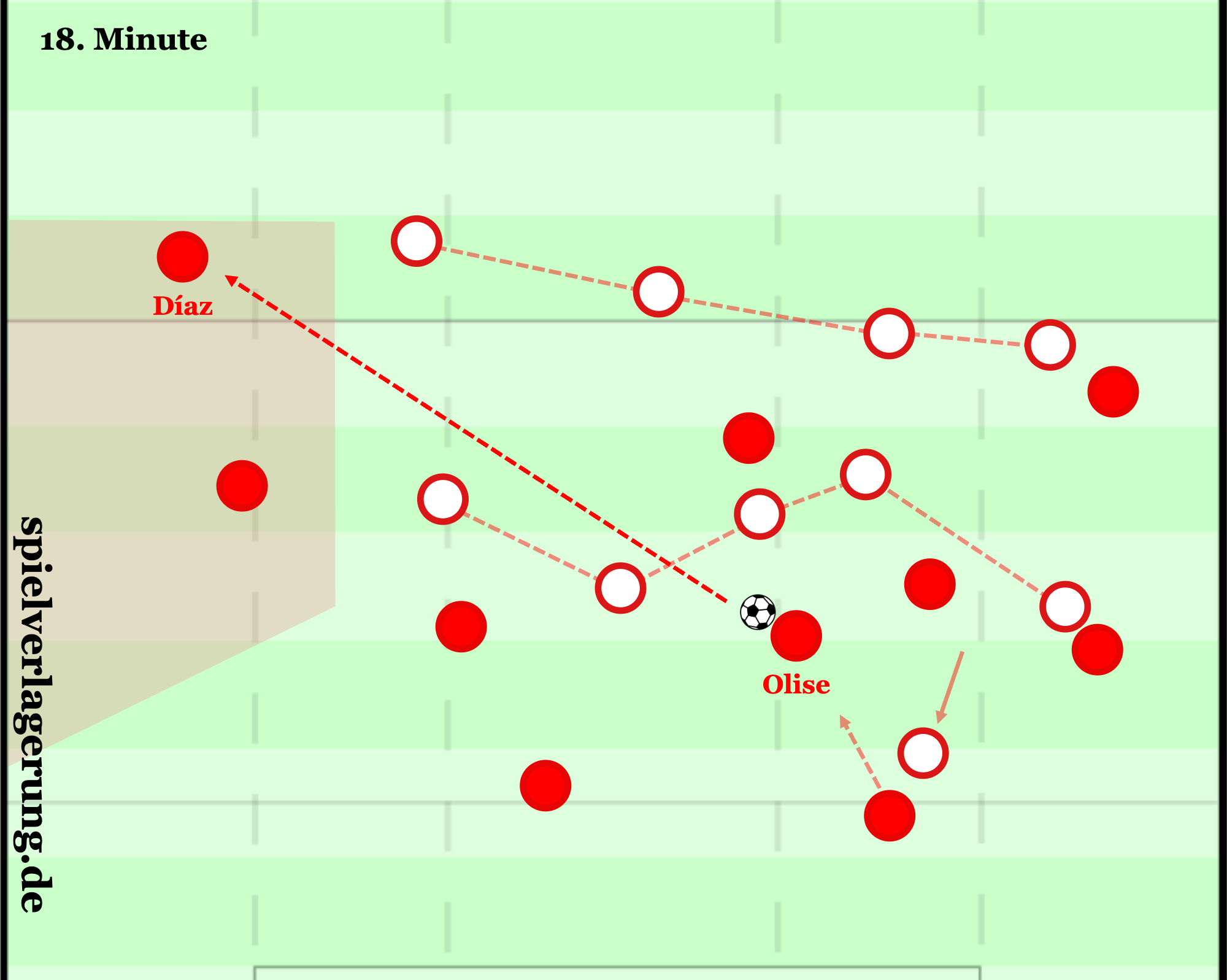
That already builds the bridge to the goals. The isolated one-on-ones in which Luis Díaz got his three finishes were not individual moments but the product of this sequence of pinning and switching.
The goals
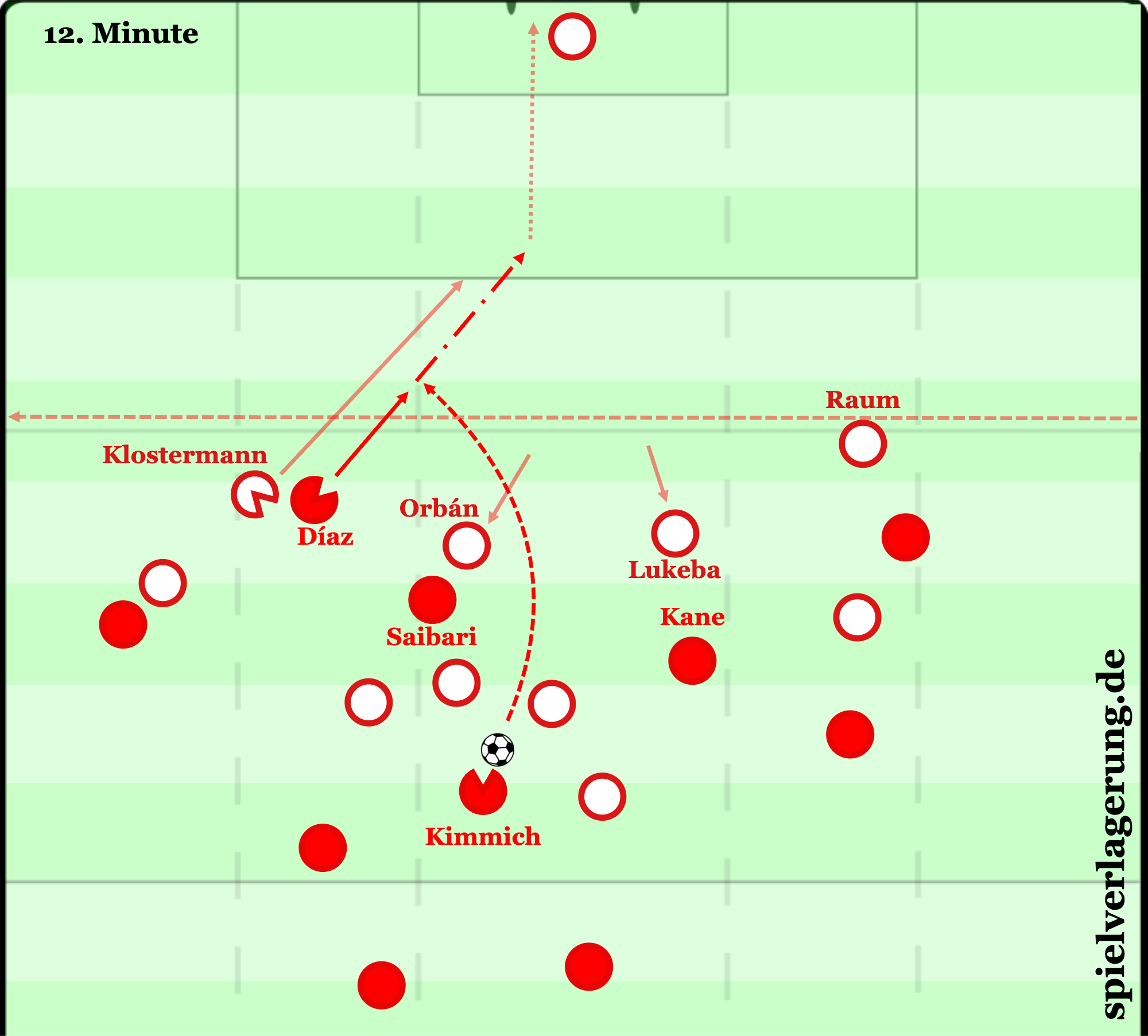
1-0, Luis Díaz (12.) – The first goal already contains the full diagnosis. Kimmich receives centrally without any pressure and can turn out with an open body shape. Ahead of him Saibari and Kane occupy the central zone in front of the box, which forces Orban and Lukeba to step out – so far, the intended part. The full-backs, however, do not push up with that movement and stay too deep, while Raum’s position plays the runner onside. Klostermann stays outside and leaves the inside lane unsecured, and that is exactly where Luis Díaz starts from. Out of that unprotected lane Díaz runs into the back line and Kimmich chips the ball in behind. Not one bad decision, but four players whose decisions did not fit together.
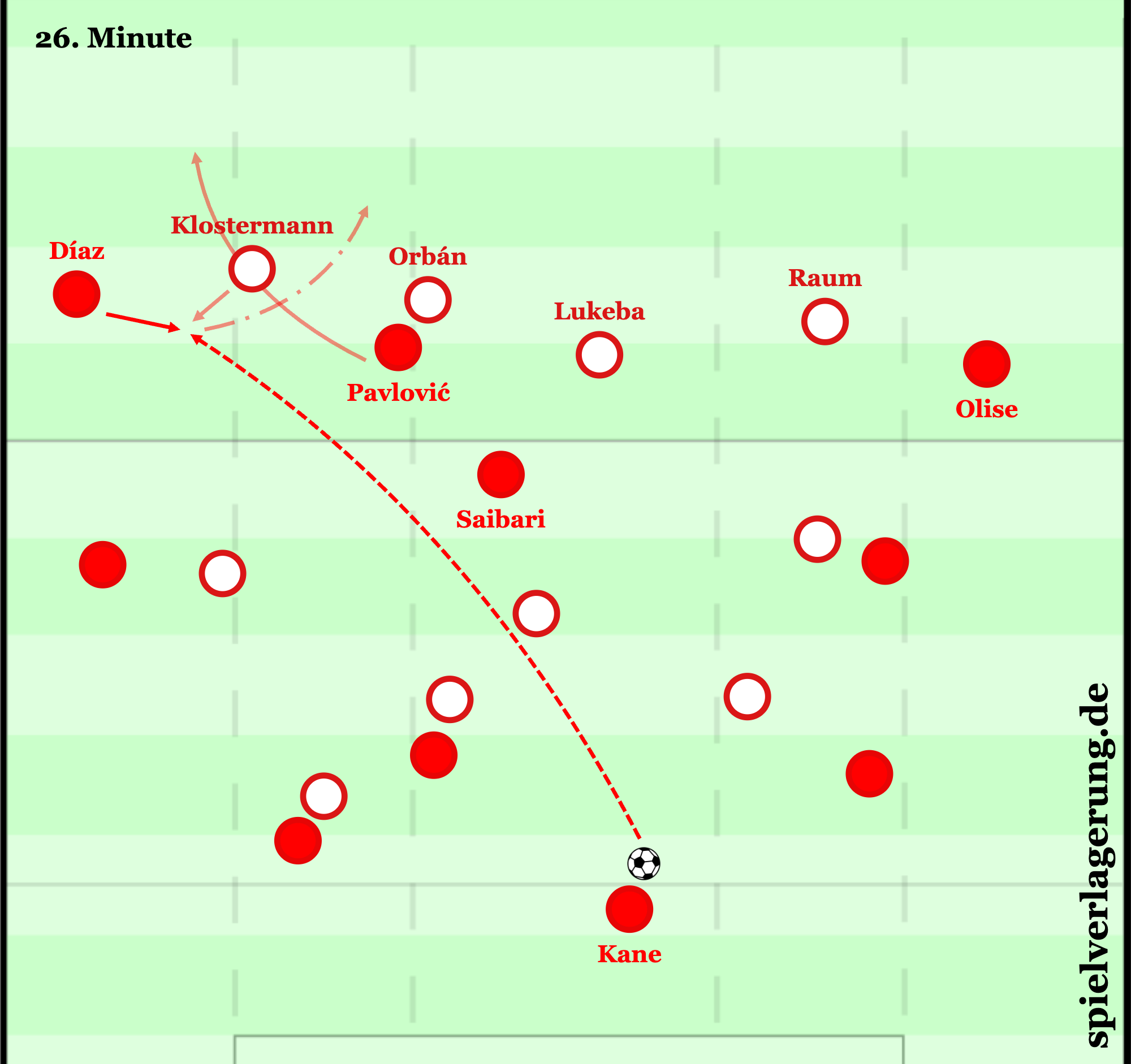
2-0, Aleksandar Pavlović (26.) – Same cause, different route. Kane drops deep and Leipzig do not shift across as a unit – the reactions showed it clearly: arms thrown up, gesturing, hands dropping again, the beginnings of frustration. Kane gets the free body shape, and with him the consequence is predictable: the long ball, high or flat. Because Leipzig are so narrow centrally, the ball flies straight through the entire zone in front of their back line. Luis Díaz moves actively into the passing lane to control it while Klostermann tries to get into his running line and does not make it – Díaz reaches the ball first. From the one-on-one he wins, Díaz dribbles centrally at Orban, which creates a four-against-three on the break. Díaz pins Orban and Lukeba centrally, Pavlović overlaps on the left after holding a high, left-leaning position all evening and threatening the back line. Two touches, left foot, finished away from the defender.
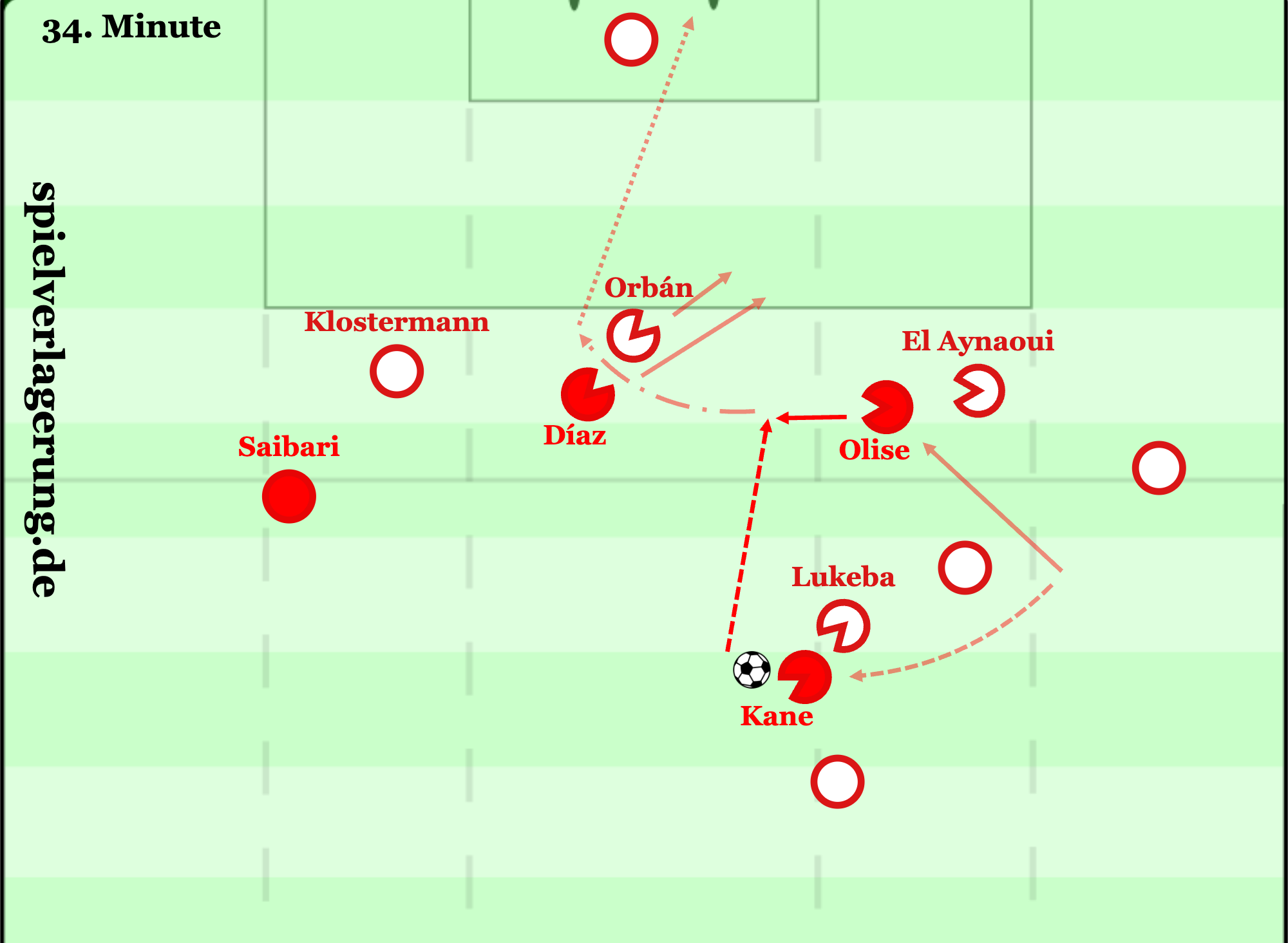
3-0, Michael Olise (34.) – Here Bayern’s press shows itself at its clearest. From a Leipzig throw-in, the man-orientation is fully visible: consistent pushing through, clean handovers. A misplaced pass from Raum then cannot be defended, because neither the tracking nor the duelling is good enough to disturb the pass. Kane can open up half-way. Centrally, Olise comes inside from the wing, and Banzuzi and his partner fail to pick him up, letting him run through – against a player of that variability, an invitation to the key pass. Luis Díaz runs beyond and drags Orban with him, Klostermann is pinned wide by Saibari and can no longer get back into central areas. Olise finishes against the goalkeeper’s movement, across his standing leg into the far corner, catching Vandevoordt completely on the wrong foot.
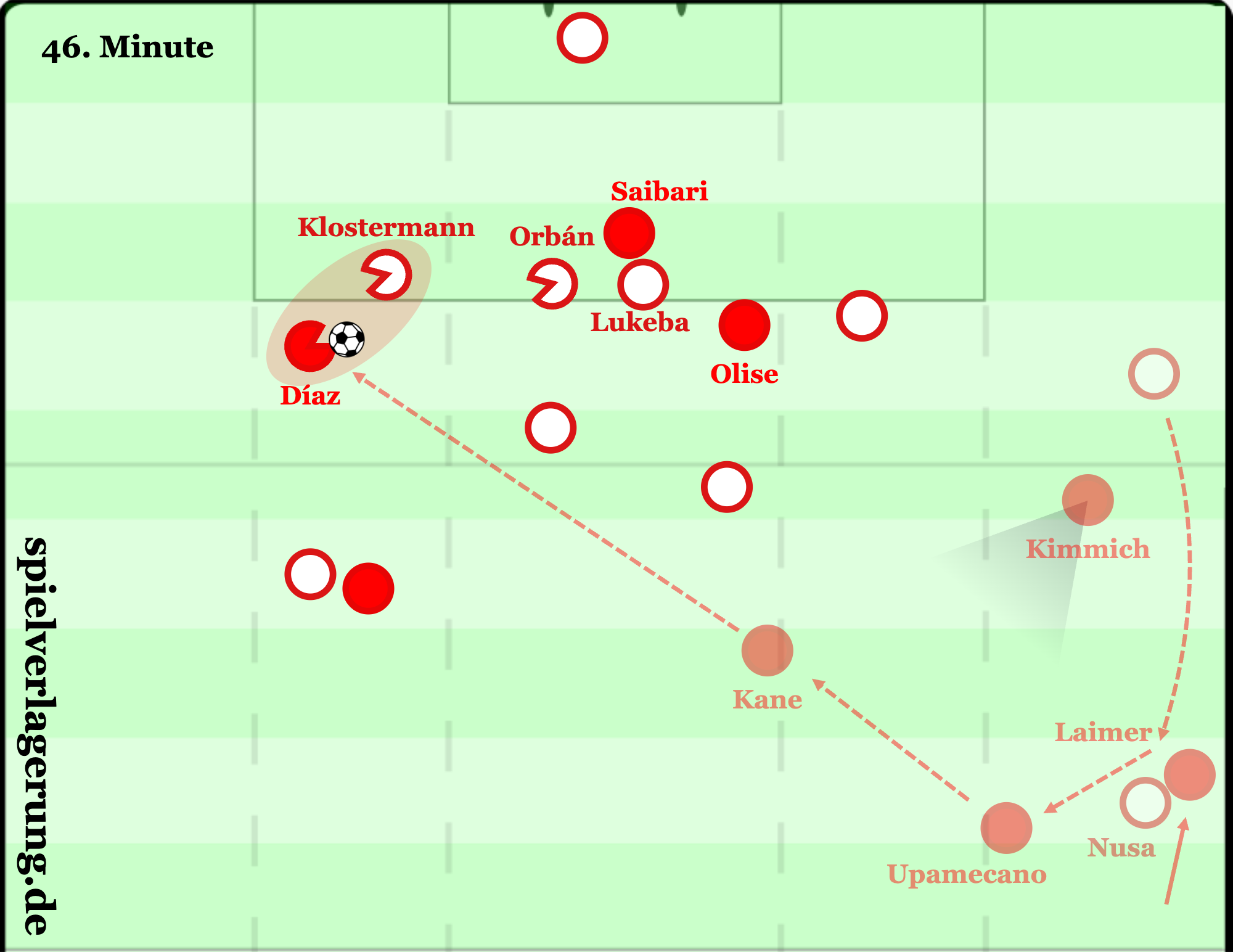
4-0, Luis Díaz (47.) – After a regain, Bayern switch quickly to the far side and once diagonally through, putting Díaz in a one-on-one again. He holds the ball in the dribble, and Leipzig fail to solve the situation in three steps: the centre is not closed, Orban is too late stepping out, Klostermann does not get into the duel. That Vandevoordt leaves the far corner open is the final piece of an isolated one-on-one that should never have arisen.
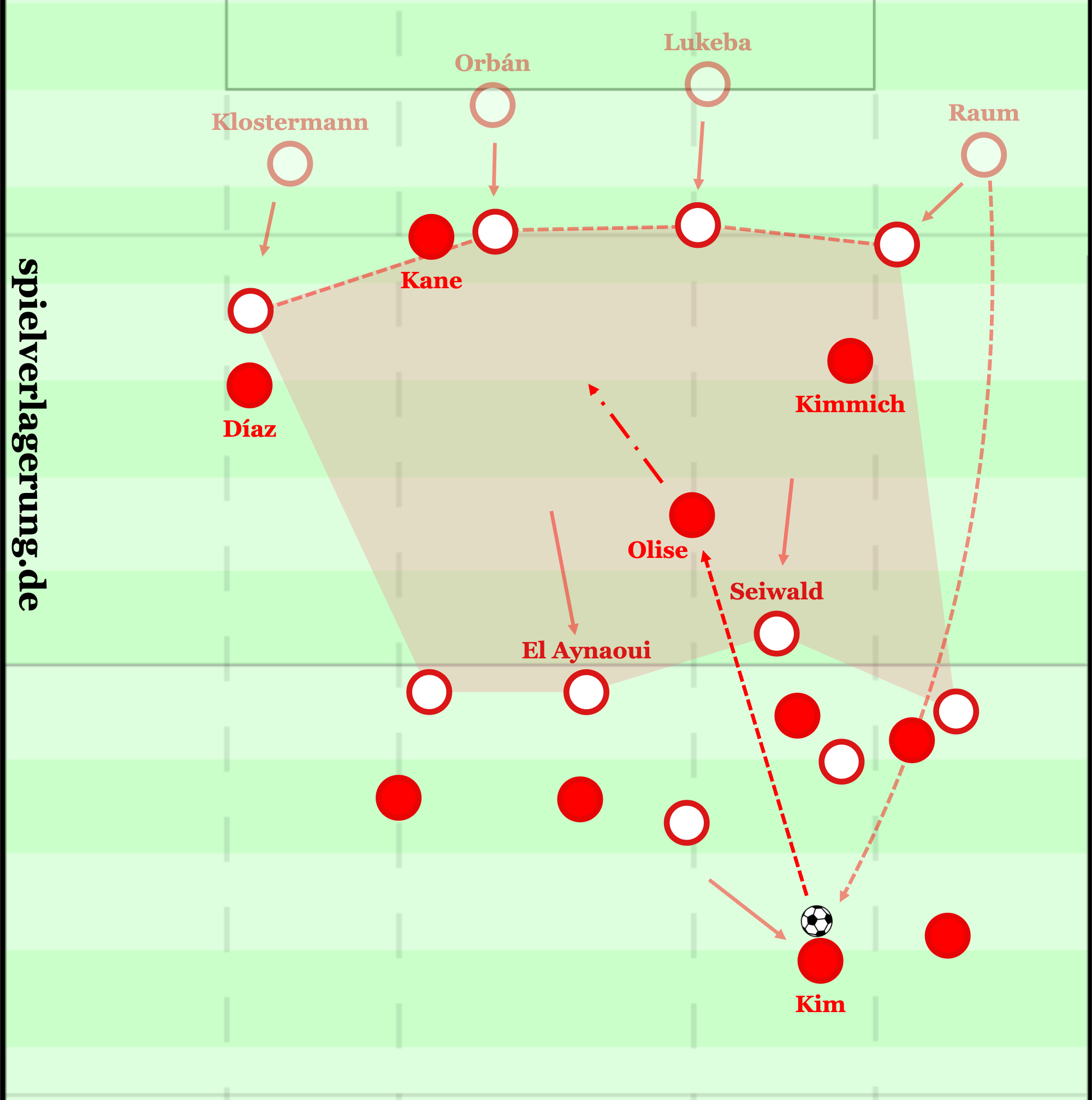
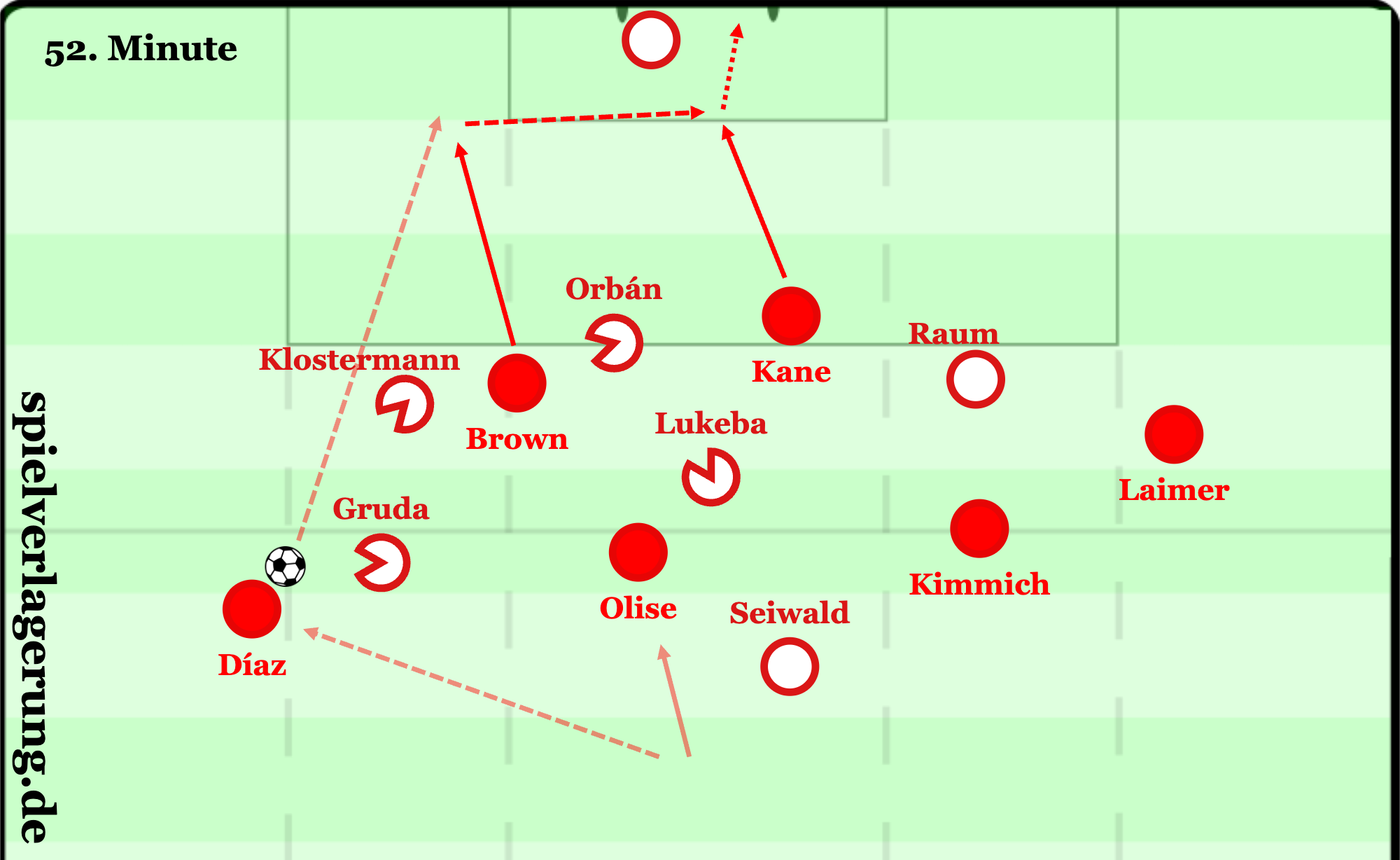
5-0, Harry Kane (53.) – Structurally the most interesting goal. Leipzig play a long ball without preparing it and react to the consequences contradictorily: the back line does not push up at all, while the midfield line and both forwards counterpress forwards. The ten space opens up enormously, the gaps between the lines become huge – and Olise is standing in that zone. One pass from Kim is enough to take six Leipzig players out of the game. Olise runs unopposed at the back line and lays it off to Díaz, who is in a one-on-one again; Brown joins for the two-against-one and shifts into the inside lane. Klostermann does not pick up his run from the deep half-space, and centrally Kane again drops into Orban’s blind side – a pattern that stood out across the whole game. The result is a two-against-one against the goalkeeper.
6-0, Luis Díaz (69.) – From a set piece Bayern create a five-against-four out wide. Gnabry pins opponents and makes the space for Díaz, Orban again takes one big step in the block and does not get into the duel. The same scene as the 4-0, only from a different phase of play – a sign that this is a behavioural pattern rather than a snapshot.
6-1, Andrija Maksimović (90.+1) – Leipzig’s goal shows in reverse what their own game had been missing. Bayern drop into a deeper block here, and Leipzig combine centrally before going wide. Gruda gets into a one-on-one against Brown, Upamecano steps across – but from above, with too wide a gap and without closing the centre. That opens the one-two, which Leipzig take immediately. Because the whole situation narrows onto that combination, the space behind it stays unoccupied, and Maksimović can take two touches on his left and finish unopposed.
What remains
The sequence of goals reads like a repetition. Five of Bayern’s six come from the same combination of no pressure on the ball centrally and a back line that does not manage the space behind it. Luis Díaz stands in an isolated one-on-one three times, Orban is twice too late with a step that is too big, Kane repeatedly drops into his blind side. Klostermann certainly did not have his best day – but it would be too easy to settle the bill with him. In the decisive scenes he faced situations that functioning protection in front of him should never have allowed to arise in the first place.
Behind it all lies not an individual problem but a structural one: Leipzig pressed narrow and found no trigger against Bayern’s rotating back three. That very compactness made the switch of play the opponent’s most effective tool, and at the end of every switch stood a one-on-one that Leipzig lost. The scoreline is not the story – the story is that the same scene worked six times.
LC is often found in a classroom, happiest on a football pitch, and occasionally on LinkedIn.
Keine Kommentare vorhanden Alle anzeigen