
Man for Man: How Brighton’s Press Suffocated Arsenal


BrBrighton arrived at the match fresh off a 3–2 win at Old Trafford, while Arsenal boasted a clean defensive record and a reputation for controlling games and seeing them out like few other teams in Europe. The match ended 3–0, sparking immense hype around Brighton’s pressing. This analysis explores the underlying mechanisms: their man-oriented pressing across the entire pitch, their asymmetrical build-up play, their transition behavior after winning the ball, and the three goals themselves.
The Basic Idea: Intensity with Control
Arteta’s Arsenal are among the best sides in Europe at controlling games out of possession. Any opponent who sets out to establish order is playing on the ground Arsenal own. Hürzeler therefore decided against control – not control surrendered in the sense of a low block, but a chaotic game state that Brighton generated themselves and were therefore prepared for.
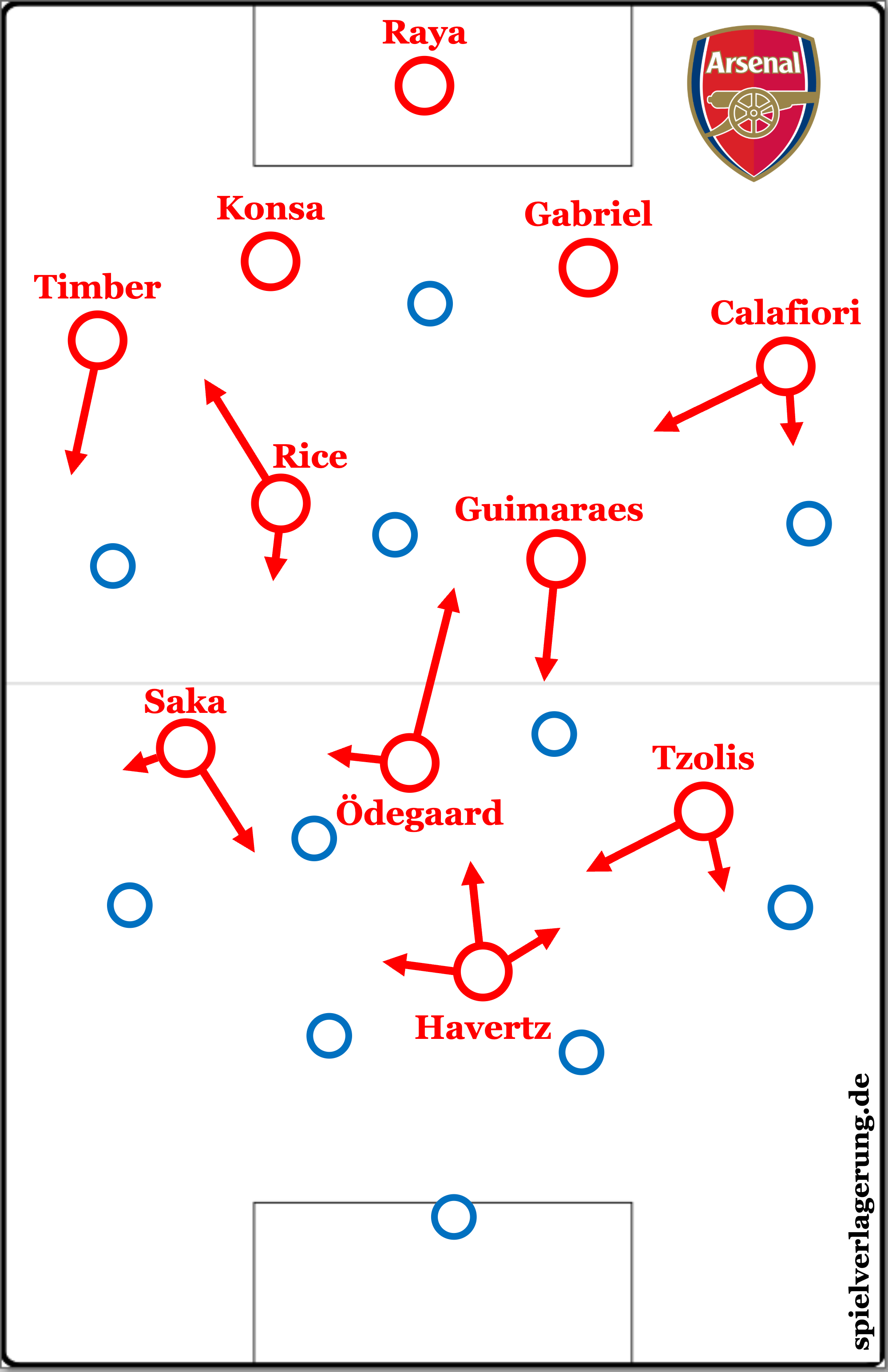
System & movement with the ball – FC Arsenal
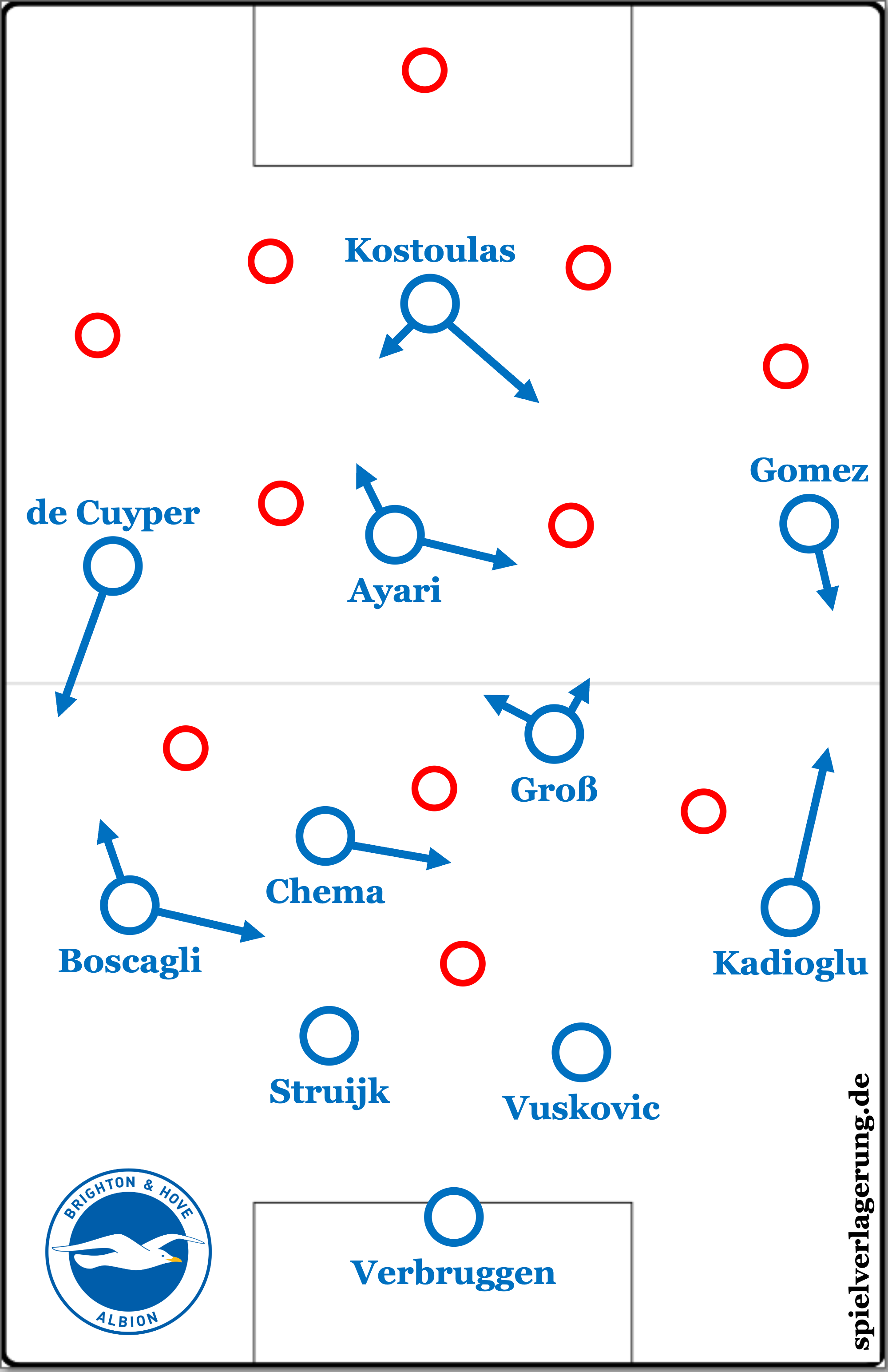
System & movement with the ball – Brighton & Hove Albion
The thread running through ninety minutes: Arsenal were not to settle into an organised phase either with or without the ball. Three decisions delivered that. The build-up was set up asymmetrically – on the right Brighton prepared the long ball and occupied the landing zone before it was played, on the left counter-movements opened the short route. It was never long instead of short, but two prepared options that would have demanded opposite answers from Arsenal. After regains the ball was not secured but risked immediately, because a secured ball gives the opponent exactly the seconds they need to reorganise. And the press lived off intensity and constantly new starting points: when a line was played through, Brighton did not stand still but re-established their shape and triggered again.
All three decisions give up ball control in the classical sense. Control came instead from preparation – if you know where the ball will land and you are standing there beforehand, you control the situation without the ball.
What followed can be pinned to a single number: 41 Arsenal turnovers in their own danger zone. That is not a figure a side of this quality produces because they play badly, but because they never reached the game state their build-up is designed for.
Out of Possession: Man-Marking Across the Whole Pitch
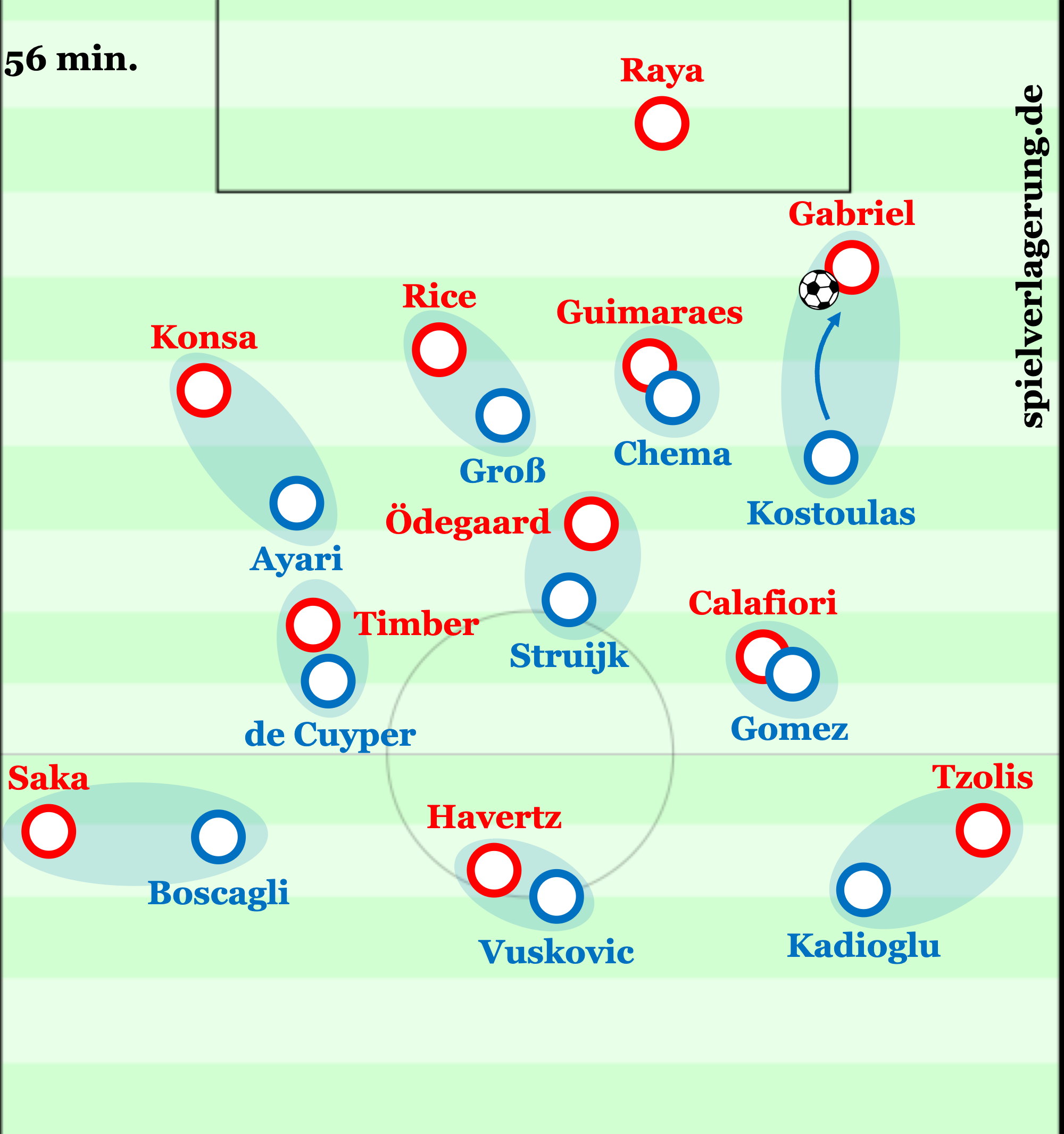
Brightons manorientated press against a 4-3-3
The press was simple in principle and demanding in execution. Brighton set up with man-reference to their direct opponent and switched into pure man-marking on the trigger. Against a side that tracks from the first second, marking assignments can be pulled apart by movement before any pressure exists; Brighton refused to offer that, because their shape stayed compact until the trigger moment.
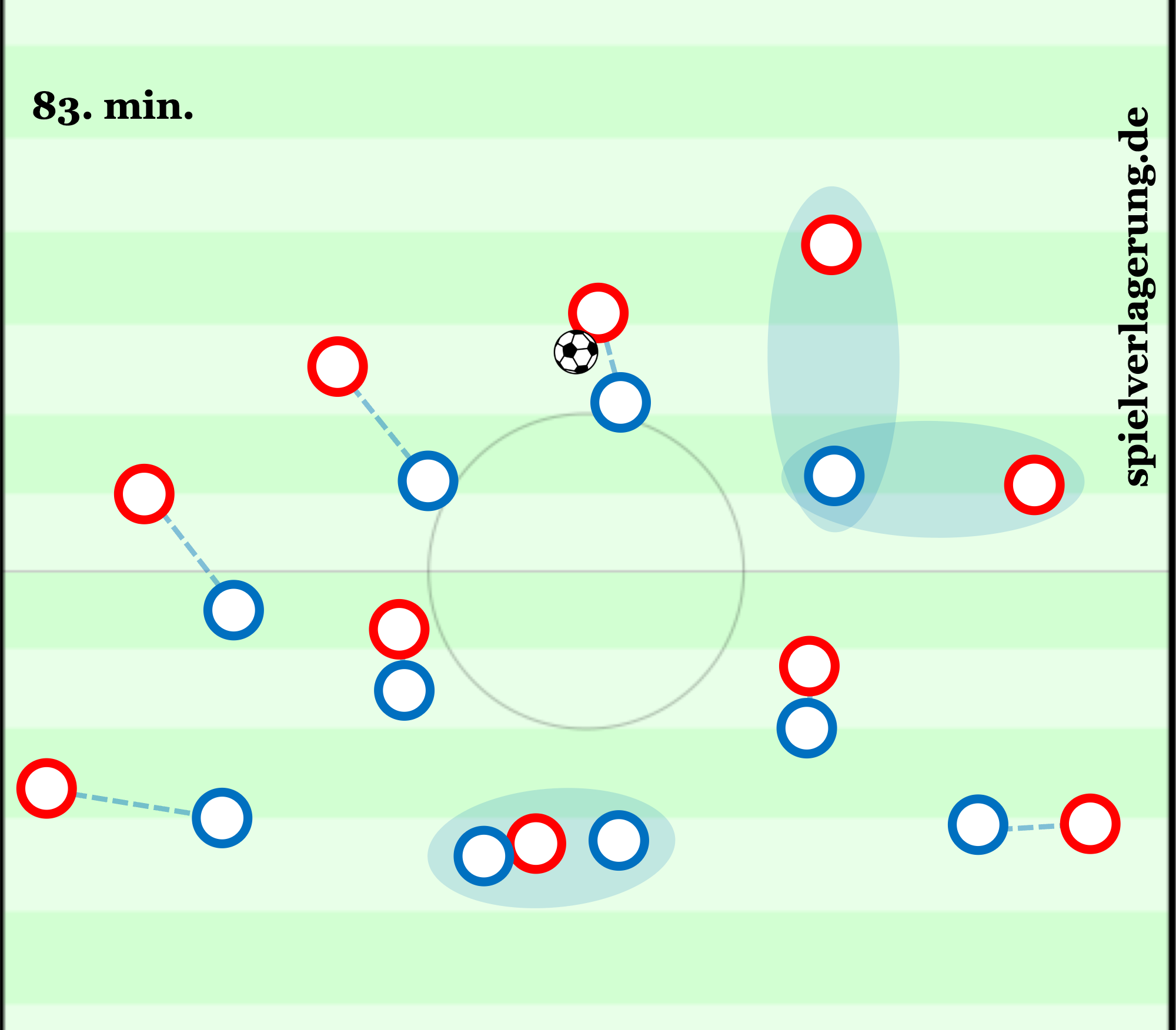
In the “mid-block,” positioned +1 on the last line, but ready at any moment to transition into a high press upon a pressing trigger.
The steering began with Ayari. He curved his pressing run so that Konsa stayed in his cover shadow and Raya was forced to the other side. Kostoulas marked Gabriel, while Chema Andrés and Groß pushed aggressively onto Arsenal’s No. 8s. Groß in particular tracked the dropping Rice and at times advanced into the first pressing line, in some sequences all the way onto Konsa. That requires Rice to be picked up by a team-mate in the same moment – the man-marking worked through handovers as much as through tracking. Centrally, the striker and the No. 10 rotated accordingly: whoever had the shorter route to the next man on the ball pushed out, while the other covered behind him and took over again on the next trigger.
It only held up because the centre-backs came with it. Vušković and Struijk stepped out onto Ødegaard and the dropping Havertz and prevented an underload in central areas. When Arsenal built with three in the first line, Brighton kept one centre-back zonal in the back line – but with permanent reference to the unmarked player in the No. 6 space, stepping onto him the moment the press was triggered. Arsenal’s numerical advantage in build-up therefore never translated into a free man anywhere on the pitch.
Raya was part of the marking scheme too. Ayari’s cover shadow left only the route through a No. 6, and under man-marking that is not an escape but a duel that begins with the first touch. Raya’s body shape reinforced it: he tended to open only half-way, which effectively removed the switch to the far side from his repertoire. Steered onto his right foot, only the right-hand build-up side remained; the left lay open for long stretches and was unreachable for the one player who could have found it.
Every back pass served as a trigger. When the ball went back to Raya or the centre-backs, Brighton pushed up as a unit and raised the defensive line. The density around the ball came less from the base shape than from the recovery runs: players who had been beaten sprinted back, and they did not run at the ball but with a cover shadow onto the lay-off option behind it. An Arsenal player with a marker in his back therefore had neither the lay-off nor the chance to turn.
This is precisely where Brighton differed from most sides who get played through against Arsenal. The usual response is to stay deep once a line has been broken and wait for the shape to settle. Brighton instead pushed up into the next line and used the mid-block to prepare the next jump back into the high press – even when that press had just been beaten. The press therefore had not one starting point per possession, but a steady supply of new ones, and Arsenal had to solve the same pressure several times within a single attack.
Arsenal’s core problem was the absence of a threat in behind. Their attempts to play through the press came without pace beyond the back line, so Brighton were never forced to turn towards their own goal. That made the press cheap: no threat in behind, therefore no need to drop the line. There are three answers to committed man-marking – movement that drags your own marker away and opens space for a third player, a dribble that beats the assignment one-on-one, or a target man who wins the long balls. Arsenal produced none of them.
The Mid-Block as a Fallback
When the high press was beaten, Brighton dropped into a 5-1-4 and inverted the priority. The five in the last line formed a deliberate overload against Arsenal’s front line – in exactly the moment a man-oriented side is most vulnerable, because its players are facing forward while the opponents are already moving. Brighton took the depth out of the situation first and only then thought about the ball again.
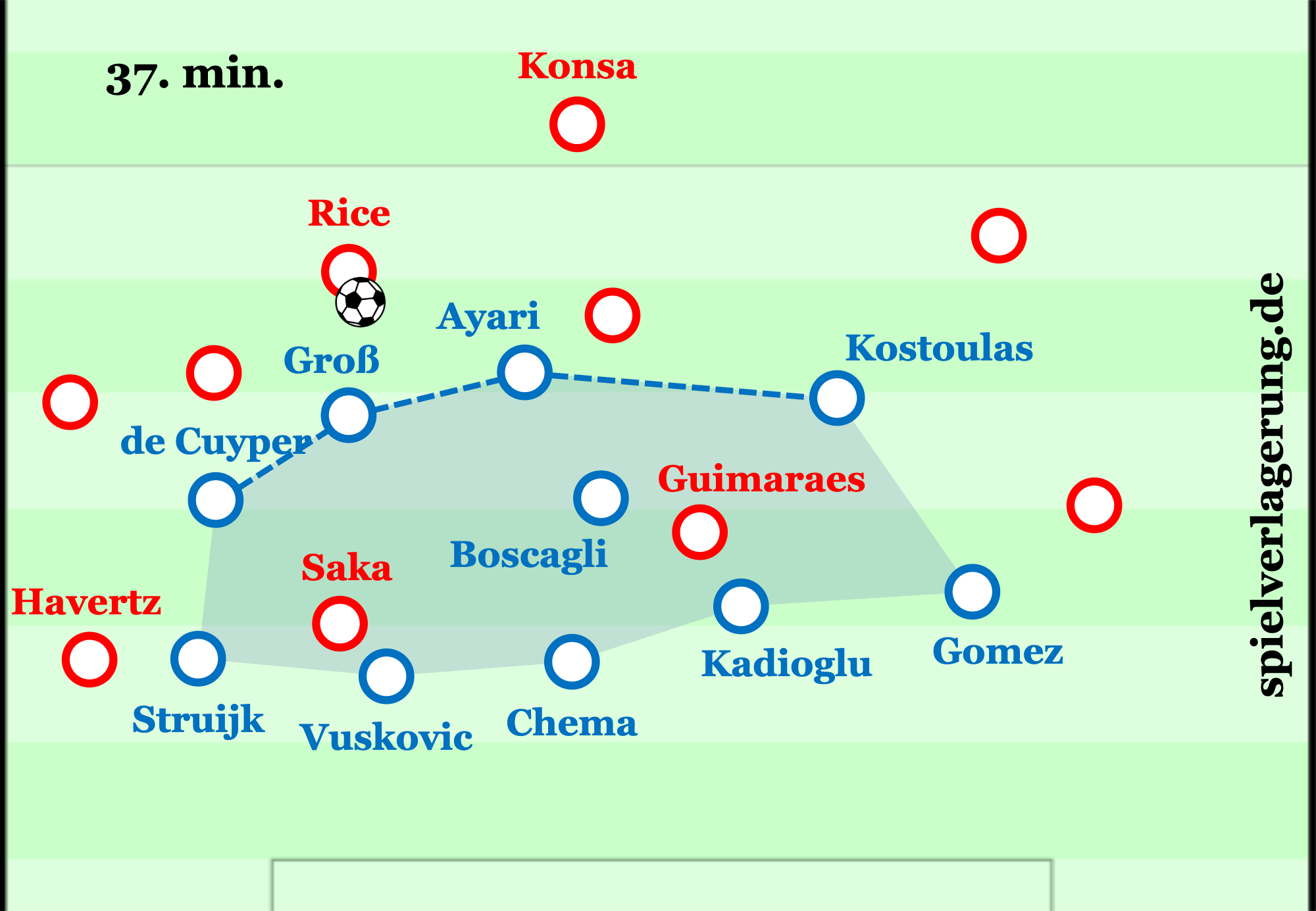
A “mid-block” in a 5-1-4 formation. The foremost players protected the “red zone” by using their cover shadows and shifting extremely compactly. Arsenal was mostly forced to play around the block, repeatedly giving Brighton time to reorganize.
A single No. 6 held the connection in front, while the four most advanced players stayed narrow and closed the centre with cover shadows rather than pressing the ball carrier. Arsenal found no central switch on the ball-near side and had to play around the block. Every trip around it cost seconds that Brighton used to shift across, so the end of the route offered the same congestion as the start. In some phases six players stood in the last line.
The block was not a terminus. At every Arsenal back pass Brighton jumped out again and restarted the high press – the same trigger as in the high phase, only from a deeper starting position. The spare man in the last line made that possible, usually Vušković: because the overload left him without a fixed opponent, he could step out, cover the depth and pick up a man himself a moment later. That freed a midfielder to push forward without leaving an assignment open behind him – precisely the point at which sides with a similar approach usually come apart.
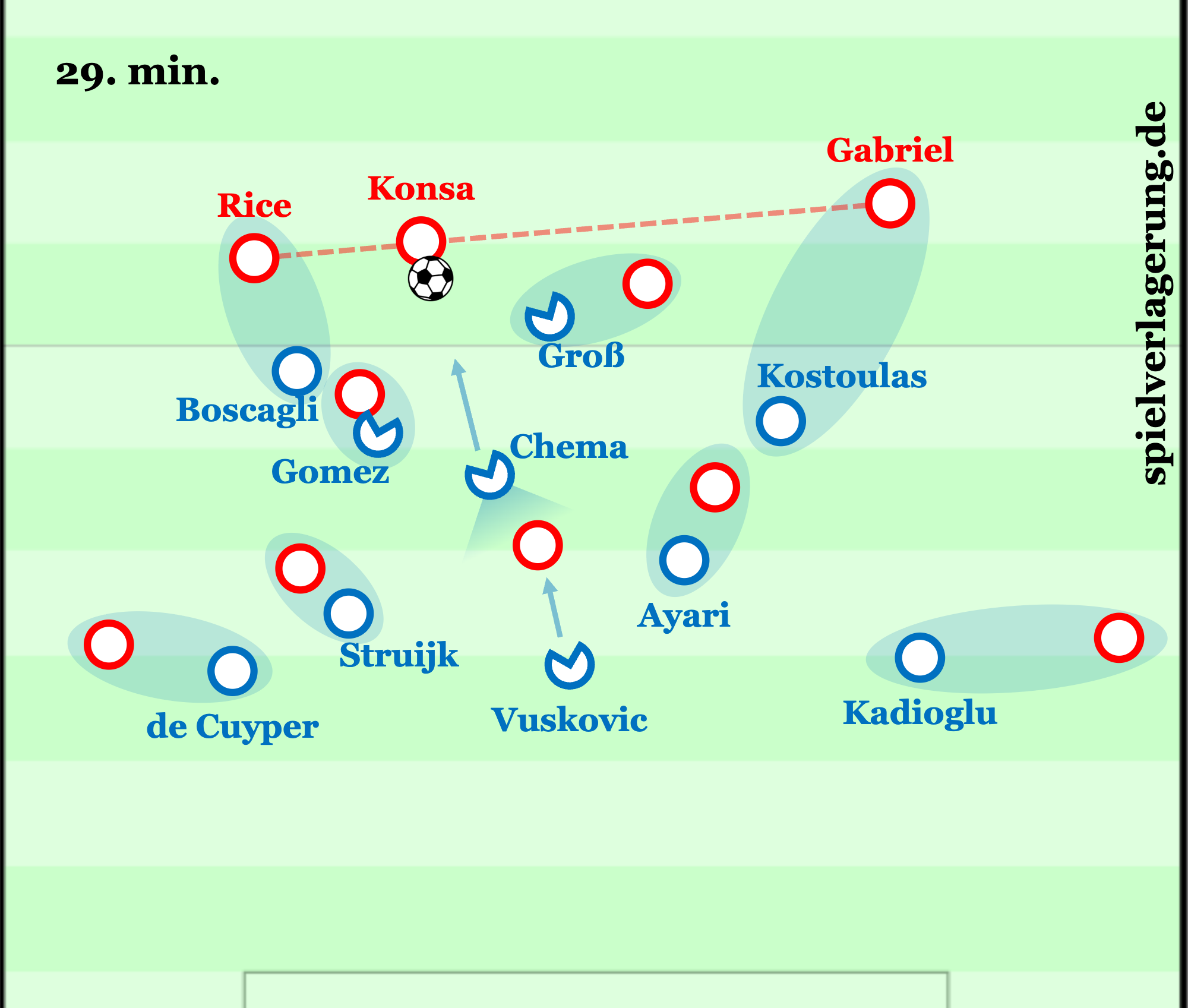
In the “mid-block” phase, the “+1” players organized themselves to execute early handovers and jump into pressing situations. Here, Vuskovic—acting as the “+1” player from the defensive line—steps up to pick up the Arsenal player operating in the number 10 position.
On top of that came the trap on the touchline. Once Brighton steered the ball wide, players jumped in from every direction: the ball-near winger closed the route back, the No. 6 covered inside, the back line stepped out. The back pass, the switch and the ball in behind did not disappear one after another but at the same time. Take away only the back pass and a side switches play; take away only the switch and they play backwards and start again. When all that remains is an individual action against several opponents with the touchline at your back, it almost always ends with the opposition.
Transition: Risk Over Retain
After a regain there are two basic options: risk the ball immediately to launch the attack, or secure it to establish order. Hürzeler consistently chose the first, and it follows directly from the overall idea – a secured ball would have given Arsenal exactly the seconds in which their structure reorganises.
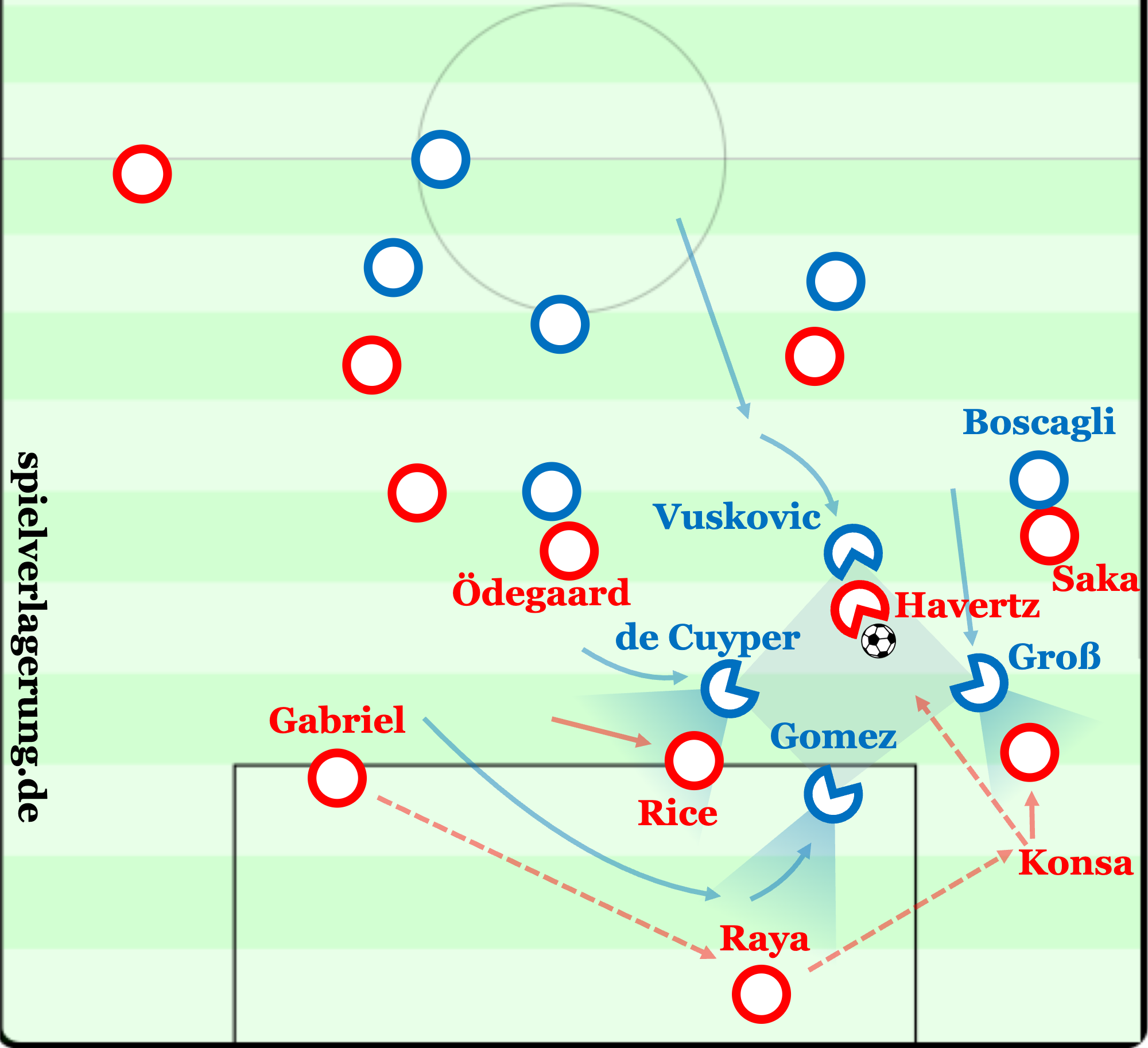
When a high press was bypassed, Brighton succeeded in forcing Arsenal into congested situations in the area in front of the back four. In doing so, the players who had been bypassed shifted to block the passing lanes of the players positioned behind the ball. This created additional pressure on the ball carrier, who was simultaneously facing pressure from the front via a “negative” pressing movement (i.e., pressing towards their own goal).
The counter was prepared before the regain. When Arsenal found a player in the No. 6 space after beating the press, Brighton immediately closed his back pass, so the turnover inevitably occurred in a moment when Arsenal were all ahead of the ball. The density around the ball, a defensive necessity, meant in attack that Brighton were central and therefore on the shortest route to goal. The first ball went to the deepest player, followed by a dribble at speed into the box, with no intermediate step and no square pass for safety.
In Possession: Bait Them In, Then Go Over the Top
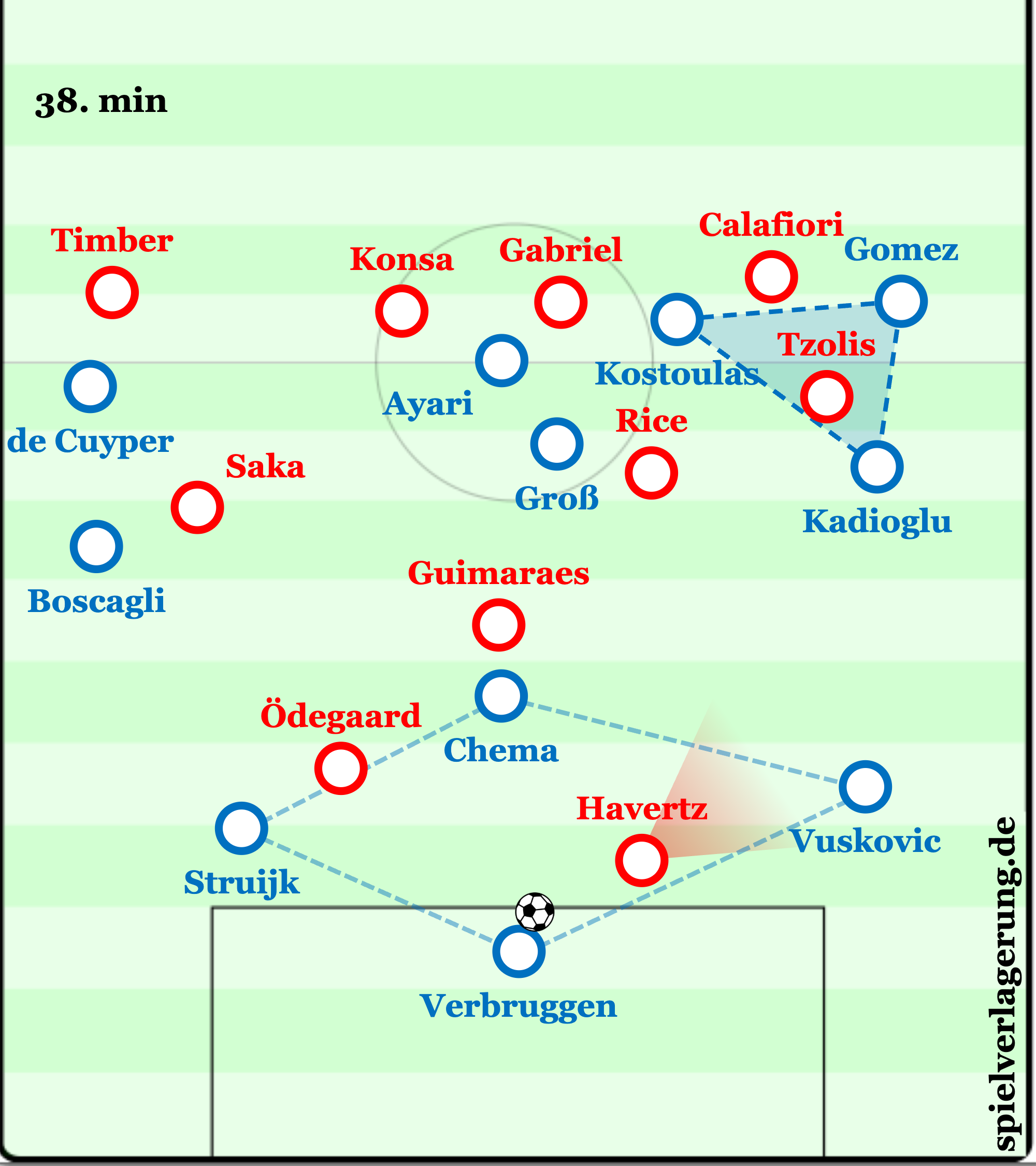
In the build-up phase, Brighton utilized a diamond shape. De Cuyper and Boscagli engaged in a 2v2 duel on the left flank, while Kostoulas, Gomez, and Kadioglu created a high 3v3 situation on the right. Briefly, both center-backs and a defensive midfielder would spread out to widen the formation. Additional support occasionally came from Groß, dropping back from the number 10 position. Ayari occupied Konsa and Gabriel through constant runs into the open spaces ahead of him.
In deep build-up Brighton baited Arsenal in deliberately. Verbruggen put his foot on the ball while the centre-backs split and lengthened the pressing runs of their opponents. On paper that produced a 3v2 against Arsenal’s first line – except Hürzeler had no intention of playing through that overload on the ground. 25 of 40 goalkeeper passes were long, 62.5 per cent, and they went overwhelmingly to the right.
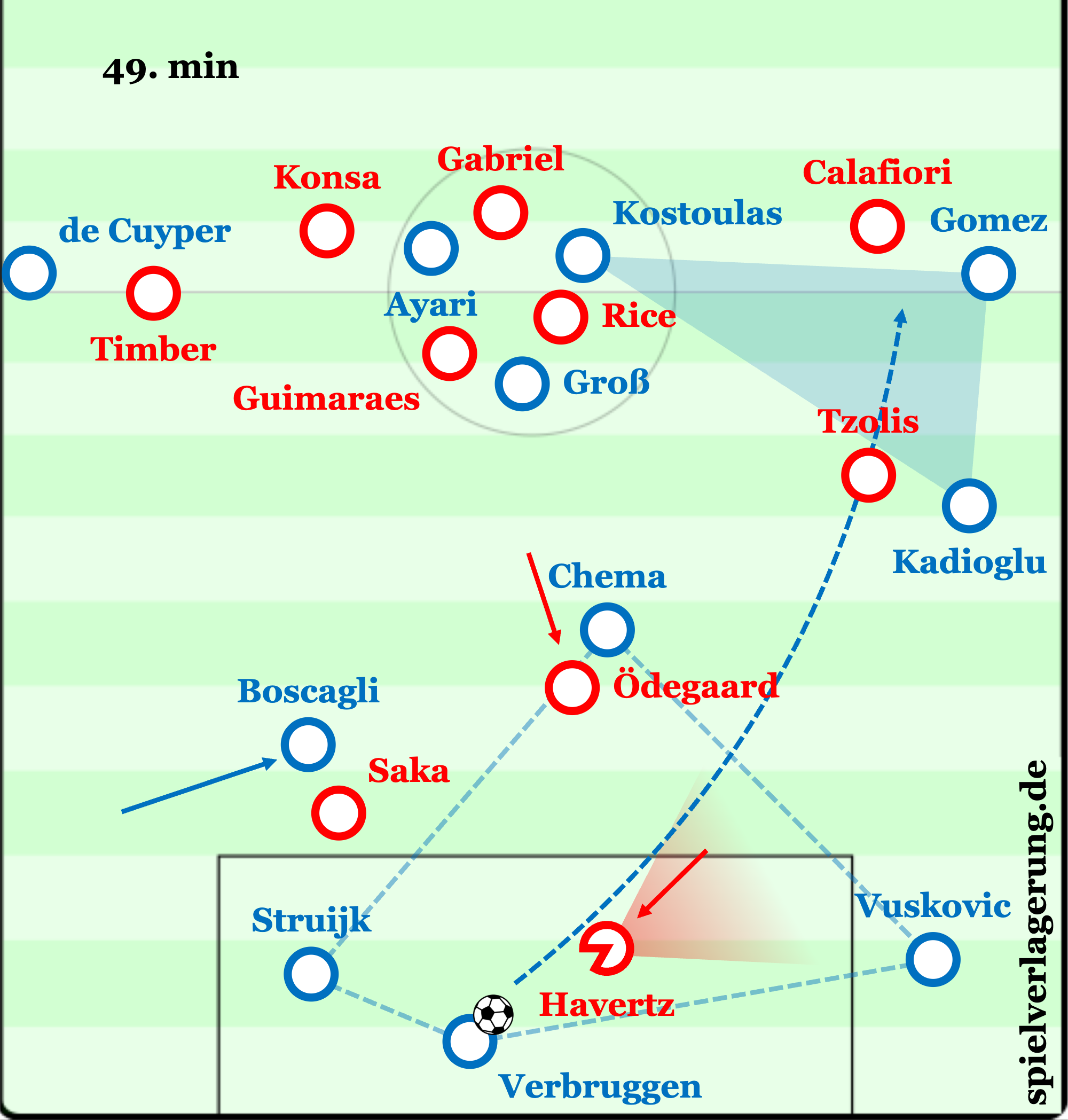
The structure allowed for a long ball to the right flank, feeding into the 3-3 formation. This created opportunities to contest the second ball or flick on the aerial pass. Additionally, Vuskovic offered a short, low passing option as the free player.
There, Brighton consistently created a 3v3 – an intact structure for the second ball regardless of whether the first contact was won. That is exactly what separates it from an ordinary long ball: the action was not judged by the aerial duel but by the situation that followed it. Kostoulas dropping added to the disorganisation of Arsenal’s high line, because a centre-back had to decide whether to follow him between the lines or let him turn. After winning second balls Brighton played on at high speed and looked for an early shot or an early cross, even against a defensive overload – again the decision for tempo over the clean attack.
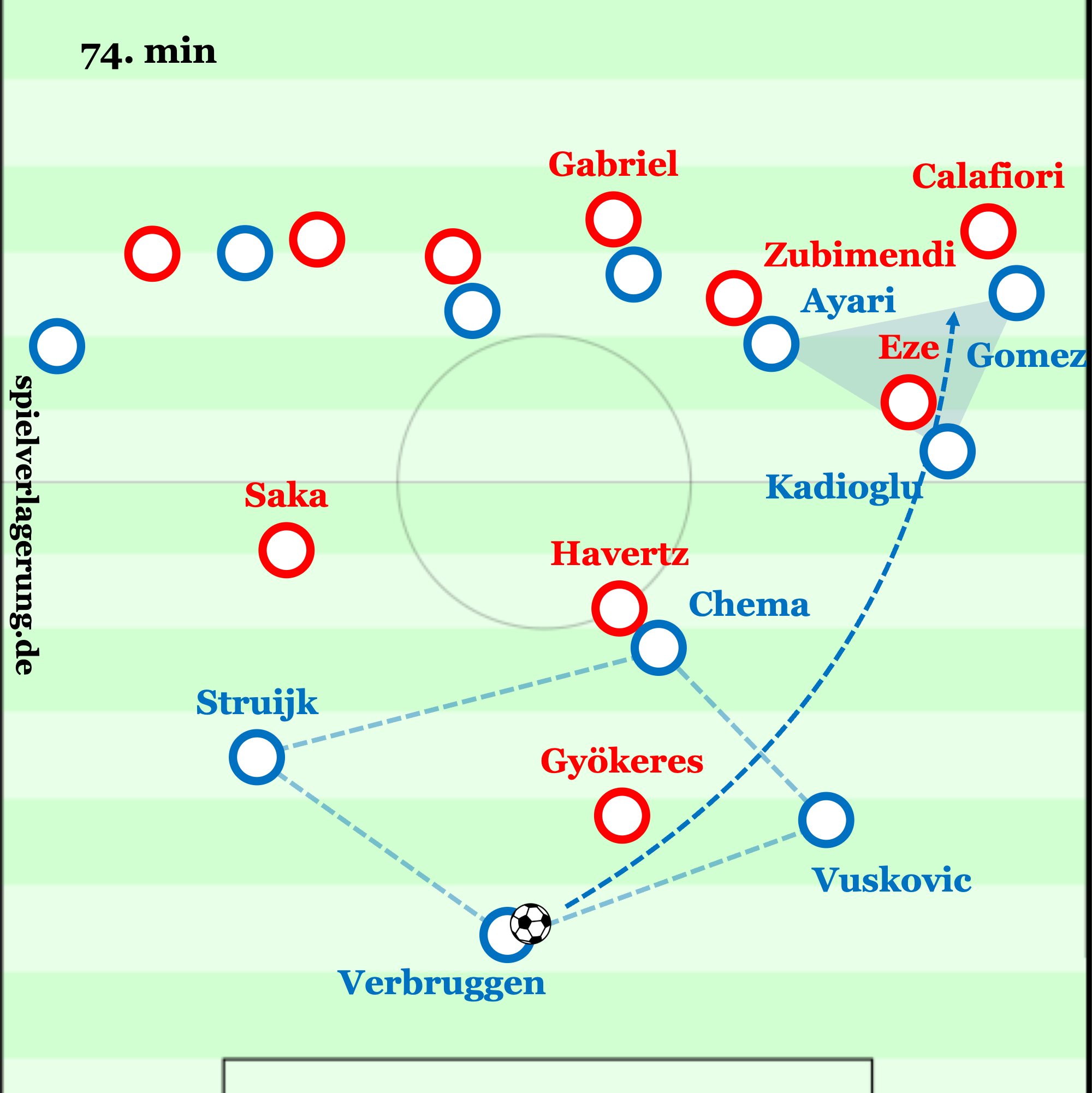
Once again, the 3-3 structure on the right flank. Here, from open play.
On the left Brighton worked through pinning rather than through length. Boscagli stepping inside dragged Saka into central areas and took him out of the wide zone Arsenal needed him in defensively, while De Cuyper dropped and offered the mid-range diagonal once the assignments had been pulled apart. The asymmetry was a personnel decision: the players for second balls were on the right, the players who could drag markers out of position on the left. Arsenal would have had to condense against one side and hand over assignments cleanly against the other.
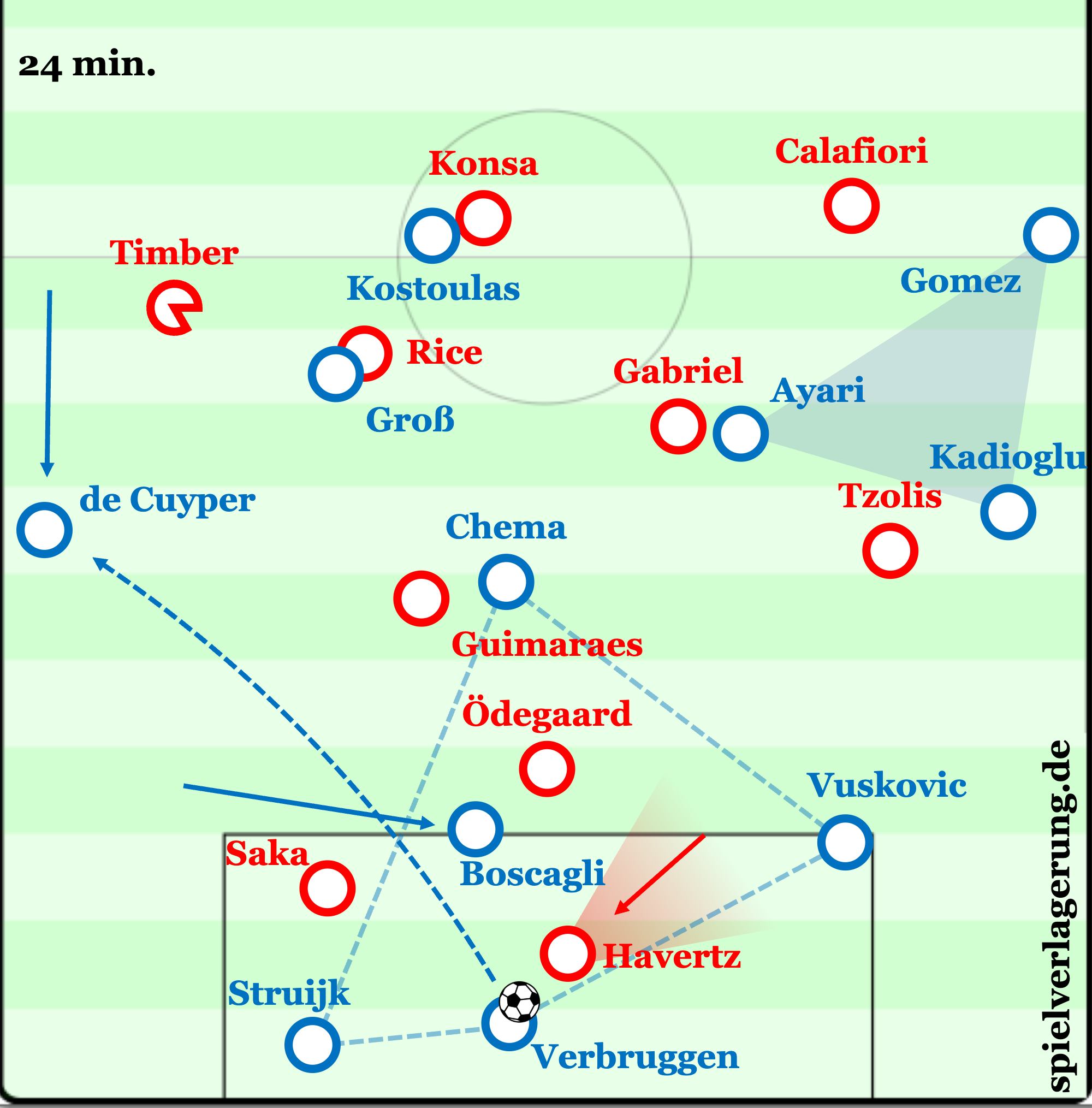
The team’s build-up play was asymmetrical, featuring a high, wide approach on the right contrasted with the left flank: Boscagli often played an inverted role—supplementing the existing diamond formation—which opened up space for de Cuyper. Meanwhile, Groß and Kostoulas occupied the players on Arsenal’s right defensive flank, enabling Brighton to find low-ball solutions against the press.
In Midfield: Stretching the Block
With the ball in midfield there were two patterns. The first was the deliberate back pass to Verbruggen to pull Arsenal’s block out, followed by the same long-short structure as in deep build-up. The back pass was not a safety option here but the tool that created the space behind the pressing line in the first place.
The second pattern worked through central and wide tension at high speed, supplemented by rotations within their own structure. Arsenal repeatedly failed to hand over their pressing assignments in a coordinated way against it – the same weakness Brighton had solved cleanly in their own press. In possession Brighton’s shape approached a 4-3-3: Chema Andrés as the deepest No. 6, Groß with freedom from the left half-space, Kadıoğlu pushing up early to support Gómez, Boscagli starting slightly deeper on the left.
The Goals as Proof of the Idea
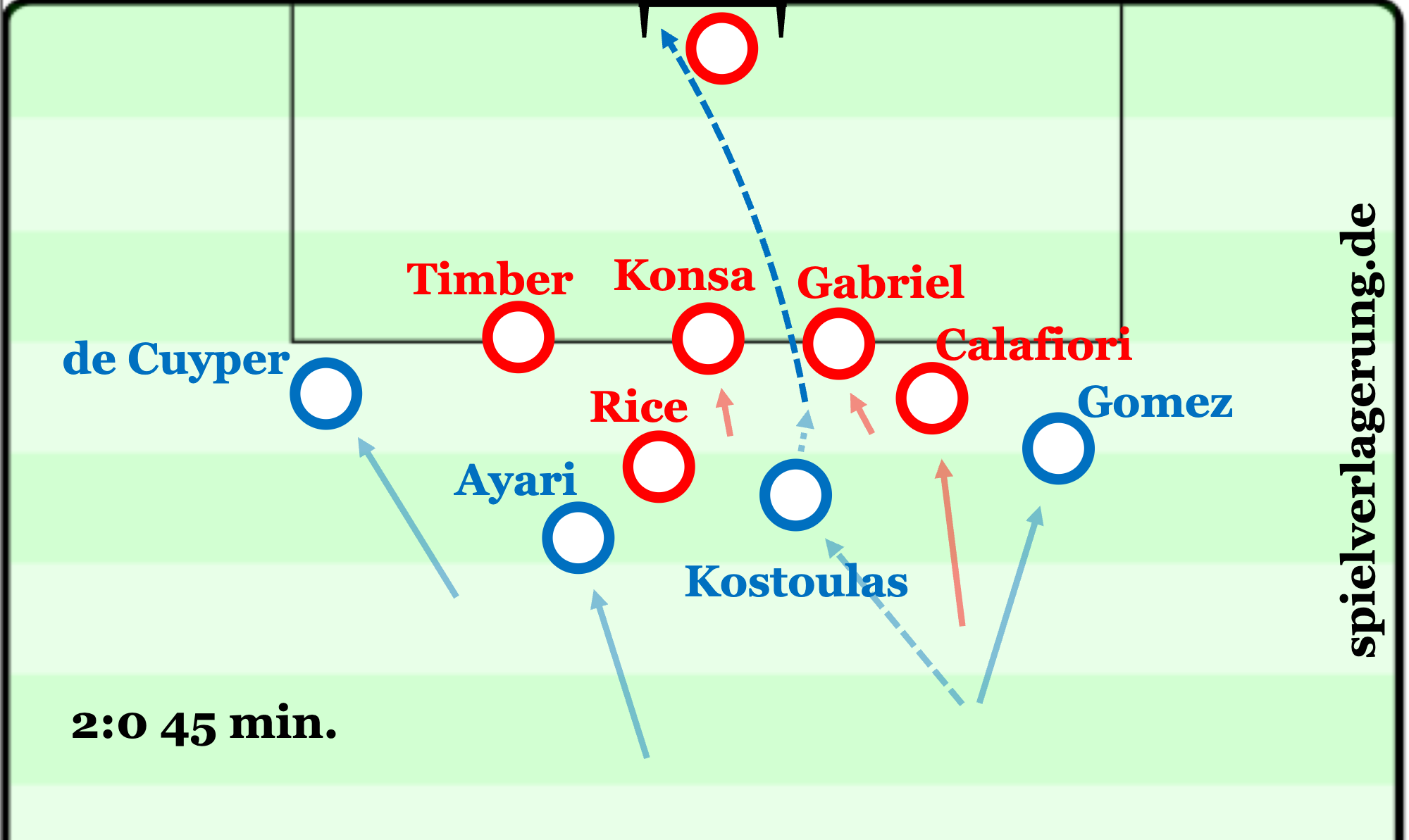
The 1-0 by Groß in the 31st minute is the whole plan in one sequence. Brighton play back to the goalkeeper from midfield, go long, lose the first contact and win the second ball. After a phase of circulation the next attack meets a back line that has already been destabilised: Kostoulas drops, Arsenal’s midfield and Konsa step out, and Kostoulas lays the ball back against the direction of the pressure to Groß. Because Ayari runs in behind at the same time, Arsenal’s defenders drop – and Groß has the time for the shot from around 20 metres. In the build-up Brighton had used rotations to drag Guimarães over to the left.
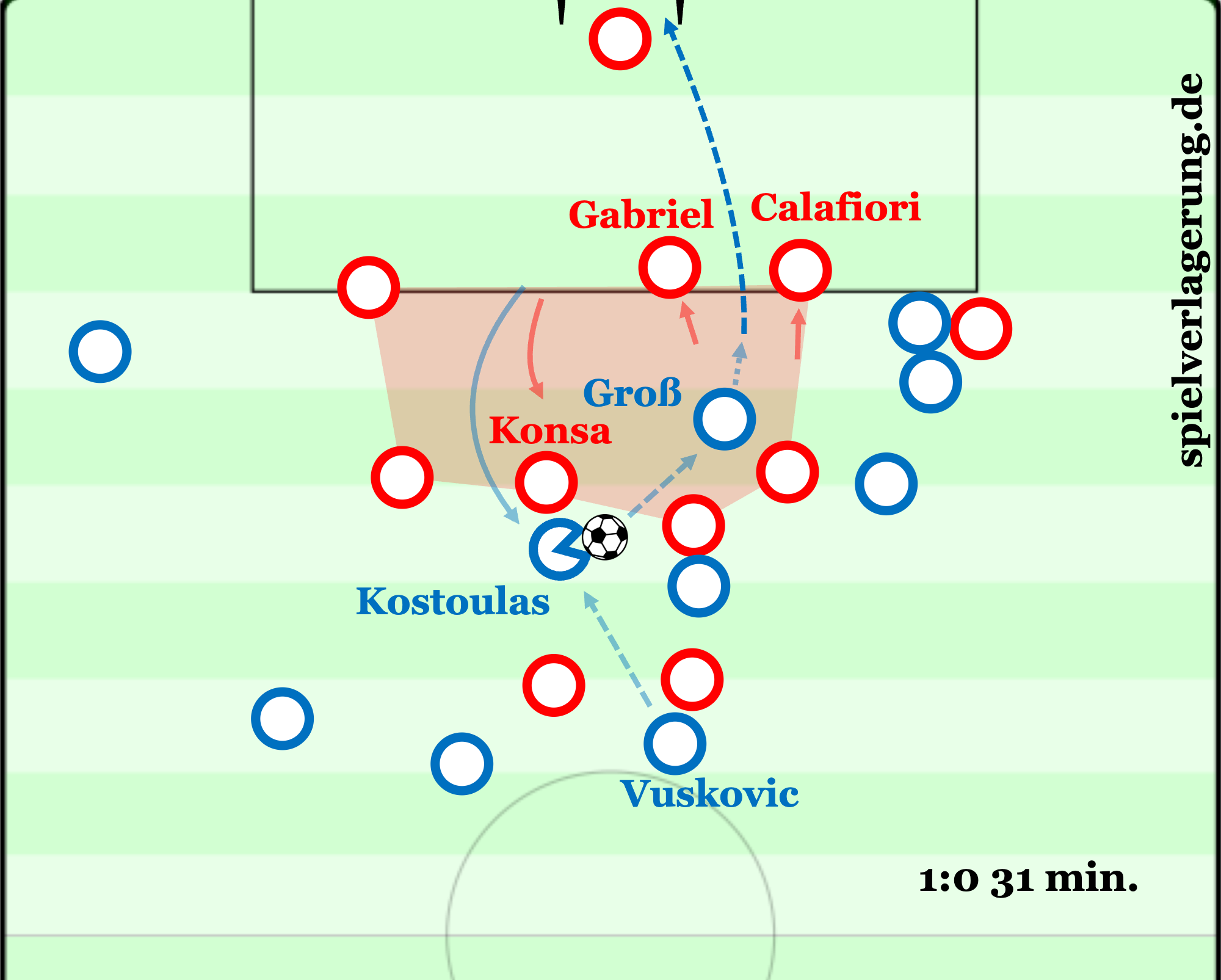
The opening goal stems from a positional attack. Kostoulas spots open space and makes a run into it. With a pass played across his standing leg, he feeds the ball to Groß in the space between the lines. As Groß takes a few quick touches and dribbles toward the defensive line, Gabriel and Calafiori drop back together, thereby opening up a shooting lane.
The 2-0 by Kostoulas shortly before half-time follows the same logic from the opposite direction. After a set piece of their own, Brighton clear an Arsenal counter and transition again immediately, 4v5 in Arsenal’s half, and once more the shot comes from distance while the centre-backs drop off.
Much like the goal that made it 1–0, both defenders went to ground near the ball carrier, thereby opening up space for the goalscorer—this time arising from a transition situation.
Both goals share the same cause: Arsenal’s centre-backs stepped out too late to press the man between the lines. React only when the shooting motion starts and you cannot get into the block from 20 to 25 metres. What is striking is that this passivity is the same one Arsenal showed in their own build-up – a side that does not leave its position to offer itself does not leave it to close down a shooter either.
The 3-0 by Chema Andrés came from a corner: Groß delivered from the left, Brighton had created an overload at the far post and protected it with two blocks, and Chema rose completely unmarked to head in off the inside of the post.
Second Half: No Game Management
Two goals up, many sides would have defended deeper. Brighton came out with unchanged and at times higher pressing intensity, and the coordination was visibly drilled: marking assignments were swapped cleanly even in dynamic situations, and Arsenal’s structural adjustments were absorbed.
Arsenal had managed a few organised possession phases in Brighton’s half in the first period; in the second it became harder. In those phases they built with a back three, Rice as the third centre-back, Ødegaard dropping alongside Guimarães and the full-backs occupying the half-spaces. Arteta reacted around the hour: Zubimendi and Merino for Timber and Guimarães, with Rice moving to right-back, followed shortly by Gyökeres and Eze for Ødegaard and Tzolis. There was no noticeable effect, because the problem did not lie in the shape but in the assignments in front of it.
There was also a layer that usually goes missing in analysis: Brighton used tactical fouls deliberately to stop Arsenal finding a rhythm. Arteta admitted afterwards that the game had been “very difficult to control”, pointing to lost first and second balls and to Brighton’s directness.
Conclusion
Arteta’s Arsenal being outplayed this clearly is rare. That it happened proactively and aggressively is rarer still – most sides who take something from Arsenal do it with a low block and efficiency. Hürzeler deliberately stepped back afterwards and praised his players’ courage, which gets to the heart of it: the plan only works if eleven players are willing to carry it through in every single sequence.
The interesting question is where the idea came from. Chelsea were a common opponent: Brighton had 74 per cent possession there and lost 3-4 against a counter-attacking side – control right down to the numbers, without return. Alonso’s Chelsea tried the opposite route against Arsenal, a deliberate surrender of control, also without success. The likely derivation lies between the two: neither give up control nor chase it, but generate the unsettled game state yourself and be prepared for it.
There is no reason for panic at Arsenal, but Arteta will need answers against a high press. The build-up was predictable for long stretches, and above all the direct option with pace in behind was missing as a threat. As long as that does not exist, a man-oriented press costs very little against this side.
For Brighton the open question is repeatability. Man-marking of this commitment, collective recovery runs with cover shadows and a touchline trap that requires everyone to trigger at once are hard to produce twice in an English week. Whether the plan works was answered on this afternoon. How often it can be produced will decide the season.
LC can often be found in the classroom, preferably on the soccer field, and—on rare occasions—on LinkedIn.
Keine Kommentare vorhanden Alle anzeigen