
Champions League Final: What the Future of Football Looks Like – MH


Which ideology will shape the football of the future? The 2026 Champions League final was supposed to provide answers to this question. After all, FC Arsenal and Paris Saint-Germain had reached the final, two teams whose playing philosophies could hardly seem more different at first glance.
A snapshot: What defines the most successful teams this season?
Under manager Arteta, Arsenal have focused this season on perfecting defending in a low block. This works so effectively in part because Arsenal combine low block defending with very high, aggressive, man oriented pressing. The combination of these two defensive styles also ensures that Arsenal’s opponents cannot adapt to just one form of defending. In attack, meanwhile, set pieces have been Arsenal’s primary source of goal threat this season. Statistics, such as their newly established record for goals from corners in a Premier League season, demonstrate this impressively.
While positional play has shaped football over the past fifteen years, it is becoming increasingly apparent that teams are neutralising the positional advantages of their opponents. The growing importance of large analytical staffs has certainly contributed to this development. These teams observe opponents’ adjustments in real time during matches and immediately relay their findings to the coaching staff.
This is precisely where Arsenal’s low block defending comes into play. It is designed to deny the opponent any positional advantages whatsoever. With Mikel Arteta, the former assistant coach of Pep Guardiola, positional play is, in a sense, being reimagined from a defensive perspective. Arsenal are regarded as one of the best examples of the systematic elimination of opponents’ positional advantages. As already suggested, this trend is not limited to the London club. It can be observed across virtually all of Europe’s top leagues. Only rarely are teams now able to generate sustained positional advantages over extended periods, such as numerical superiorities or free players.
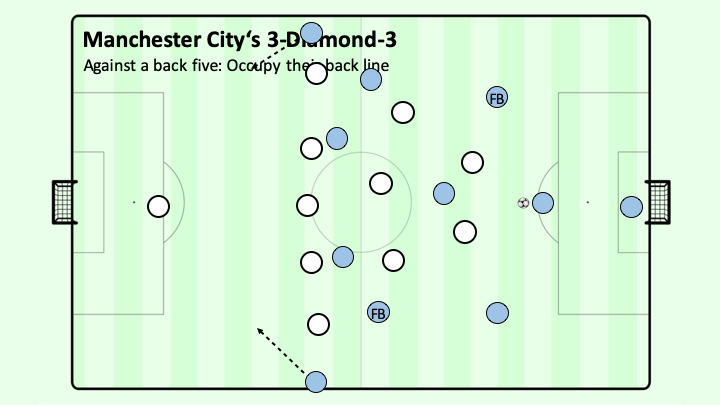
An example of Manchester City exploiting a positional advantage – from “How Guardiola’s 3-2-2-3 Ultimately Solves Defensive Play”.
The most offensively successful teams in Europe are no longer distinguished by creating chances from positional advantages controlled by the coach. Although Paris, under coach Enrique, who also comes from the school of positional play, fundamentally pursues a positional style, chances are not created solely through positional advantages. The two other most offensively successful teams in Europe, Barcelona and Bayern Munich, likewise no longer rely on purely positional attacking play. In particular, the highly successful Barcelona side mainly display typical relationist patterns in possession that are no longer based on the classical positions.
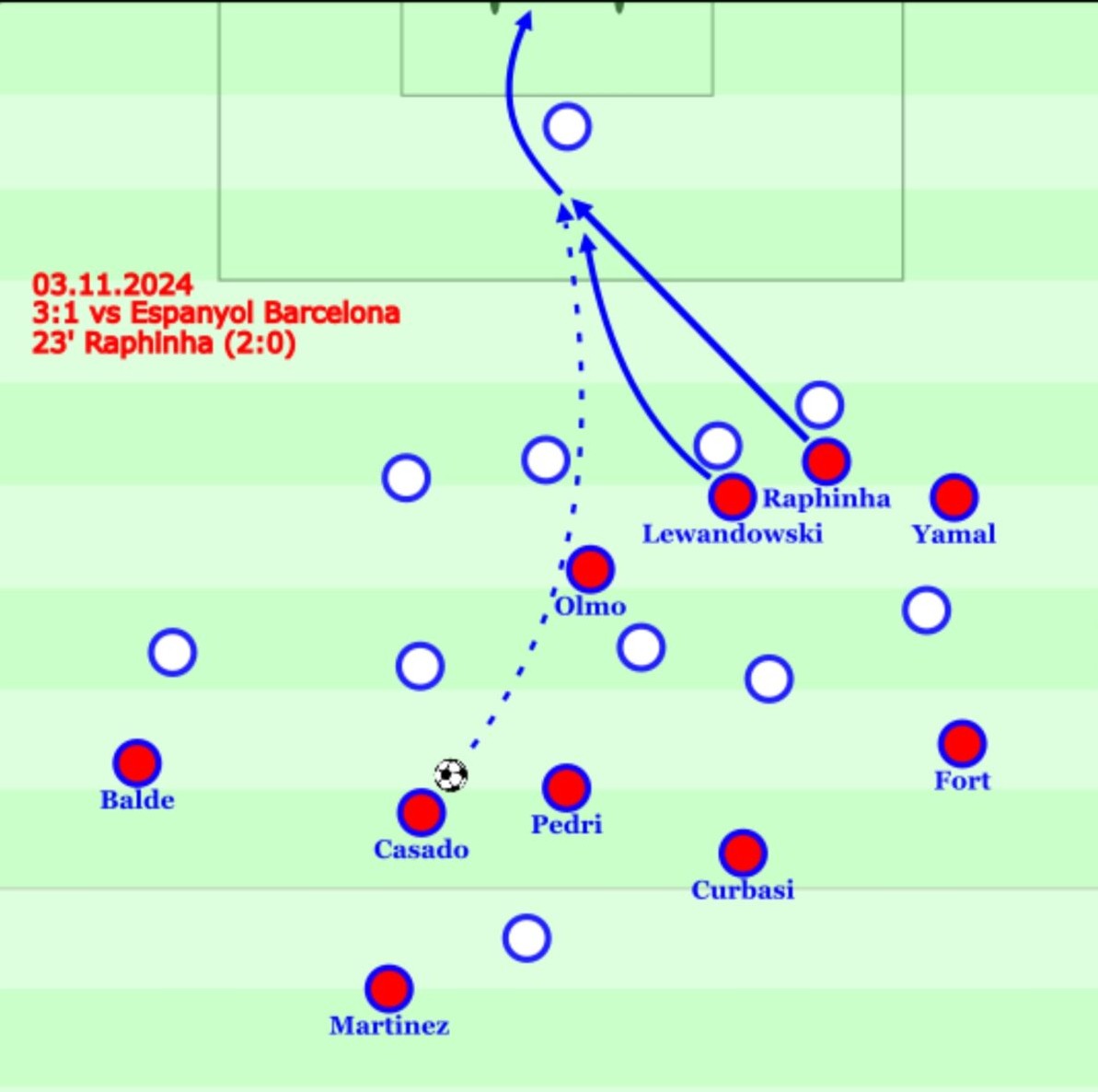
The exemplary execution of an attacking move without classical positions – from “Barça’s 174 Goals: How Flick Built Europe’s Best Attack”.
How we should not(!) make predictions
It is remarkable how much significance is regularly attached to the Champions League final when discussing what the future of football will look like. Ironically, the Champions League is a competition whose format makes it comparatively susceptible to randomness and short term fluctuations. After all, the champion among Europe’s best 24 teams is not determined through a league system over a large number of matches, but through a knockout format in which individual games, or even individual moments within games, can have enormous consequences. The smaller the sample size and the greater the importance of individual matches, the larger the influence of chance becomes.
From the perspective of forecasting, this is a fundamental principle. Future developments should not be predicted on the basis of isolated events, but on recurring observations. A single match, even a Champions League final, provides only an extremely limited data set. It may offer indications of existing trends, but it is hardly suitable as proof of a future development. In forecasting research, this is referred to as the danger of assigning disproportionate significance to extraordinary or sensational events and drawing far reaching conclusions from them. This tendency can be observed regularly in football, and particularly in this context.
Attempting to determine the future of football solely on the basis of a Champions League final would therefore be a serious misjudgment, regardless of how dominant or spectacular the winner may appear. Developments that can be observed across many matches, different competitions, and multiple teams are far more informative. Only when certain aspects repeatedly prevail under different conditions can they be regarded as robust trends.
It is therefore all the more surprising that many coaches and clubs nevertheless tend to interpret individual matches at the highest level as blueprints for the future. This often leads to a kind of tactical overreaction: a team wins a prestigious competition with a particular approach, after which numerous imitators attempt to copy its superficial characteristics. Anyone seeking to understand the future of the game should focus less on the result of a final and more on the underlying trends that emerge across a broader body of evidence. Fortunately, this year’s Champions League final did not produce a clear winner (and especially not Arsenal!).
A more robust foundation would, for example, be the analysis of the championship winning teams in Europe’s top leagues. International performance should only be considered as a supplementary indicator because of the increased degree of random variability involved. In this context, Arsenal, Bayern, Paris, and Barcelona deserve particular attention.
A Seeming Contradiction of Ideologies
“Formidables v Expendables? PSG v Arsenal could be a classic” – The Guardian
“PSG Meets Arsenal: A Final of Contrasts and Milestones” – NeunzigPlus
“Attacking Football Wins [After a Penalty Shootout]” – 11 Freunde
“Attacking Spectacle Meets Defensive Fortress” – Die Welt: “PSG vs. Arsenal: Title Defence or Historic Coronation?”
Many analyses before and after the Champions League final contrast two opposing football ideologies. This is often accompanied by the assumption that the respective styles of play fundamentally contradict one another and cannot be reconciled. According to the implicit logic, the winner of the match would determine which approach will shape the future of football. Will we see spectacular attacking football with a multitude of goals in the future, or an increasingly “pragmatic”, defensively oriented game? Following this interpretation, the final should have provided an answer to that question had the result been different.
In reality, however, with regard to the future development of football, this is merely an apparent contrast between two ideas that only at first glance seem hardly more different. On the one hand stands the perfection of low block defending, on the other a style of attacking play that is less oriented around positions. These approaches are by no means mutually exclusive. In fact, they can be combined exceptionally well.
Strictly speaking, Arsenal already provide an example of a team that has successfully combined two supposedly contradictory dogmas. There, phases of deep defending in a low block alternate with aggressive, man oriented pressing. Who would have thought 15 years ago that a team could simultaneously be one of the best pressing sides in Europe and still defend deep on a regular basis?
High man marking pressing currently unites almost all successful (and unsuccessful) teams in Europe. It removes positional advantages from the opponent, places them under constant pressure so that they cannot establish control through possession, and has therefore become a particularly effective defensive tool. At the same time, it seems entirely logical that, with the growing spread of less position bound possession strategies, the current principles of man marking will also have to evolve.
If any prediction for the future of elite football can be derived from the Champions League final, it is that success will not depend on individual, seemingly distinct ideologies, but rather on the combination of elements from the best teams, adapted to the strengths of the players available. The ability to defend both compactly in a deep block and with maximum intensity in a high press will be just as indispensable as an attacking game that does not depend on finding large spaces in the opposition’s structure. The most successful teams of the future will be those capable of combining these different modes of play.
For precisely this reason, we should be cautious about predicting the future of football based on today’s ideologies. The categories of football tactics are ultimately only provisional descriptions of our current understanding of the game. Particularly revealing are developments that break apparent rules. They show where our models reach their limits and where new tactical possibilities emerge. A prime example of this is the development of relationism, which challenges many assumptions underlying the European possession based game, positional play, and offers solutions in the tightest of spaces. The future of football will therefore most likely not lie within existing, rigid schools of thought, but rather where their boundaries are transcended.
Homogeneity in Football Tactics
“I think today we saw a lot of good, intense defending. The distances are just so, so small. And you only have two options. The first is: go all in. The second is: drop completely. The space in between doesn’t work against players of [PSG’s] level, and it doesn’t work against players of our level either.”
— Vincent Kompany after the first leg against Paris in the Champions League semi final
It seems entirely logical that defending in elite football will increasingly concentrate on two extremes in the near future. On the one hand, there is aggressive high pressing, which aims to deprive the opponent of time and control in possession. On the other hand, there is particularly deep defending in a compact block, designed to prevent high quality chances against positional teams.
Nevertheless, the more varied a style of play is, the more difficult it becomes for opponents to prepare for it. The more closely teams resemble one another in their principles, the easier it becomes to identify recurring patterns and target them specifically. The history of football tactics is shaped by precisely such developments. Dominant ideas provoke counterreactions. Positional play, for example, only came under pressure through new forms of man marking defending.
If, in the future, almost all teams rely on the same defensive solutions, new attacking strategies will eventually be developed to counter them as well. For this reason alone, it seems unlikely that the entire future of defending will lie exclusively in the two extremes of man marking pressing and space oriented deep blocks. Teams will continue to search for ways to confront opponents with different attacking and defensive concepts and thereby present them with constantly changing challenges. It is precisely when tactical approaches become too widespread and therefore familiar to teams that the conditions for successful innovation emerge.
Conclusion
What will the football of the future look like? Neither will a single currently dominant ideology shape the future of football, nor can a single Champions League final reliably provide insight into the game’s long term development, regardless of how it ends.
What remains is the hope that coaches and analysts will become somewhat more creative in the future. Rather than searching for answers about the future of the game (or their own teams) in Europe’s biggest match, they should focus more on developing new solutions and questioning established assumptions. The next major innovation in football tactics will most likely not emerge from the confirmation of existing ideologies.
Author: MH is a football aficionado at heart. His apartment resembles a football library, with shelves filled with books on the great tacticians from Rinus Michels to Pep Guardiola. Of course, the book from Spielverlagerung.de is not missing. For MH, football is not just a game, it’s a way of life. He can be found on X under Mh_sv5 and LinkedIn.
1 Kommentar Alle anzeigen
Wade July 11, 2026 um 12:10 am
Bonjour je suis nouveau,je viens de découvrir ce site et pour cet article était ma 1ere lecture (d’une longue serie je l’espère) je suis ici pour me cultiver et donné a manger à mon cerveau pour qu’il s’enrichissent intellectuellement et rendre l’analyse plus simple à mes yeux,bref j’ai lu cet article et j’ai l’impression que le moment qui résume le plus l’article,et celui qui m’a le plus marqué, c’est celui là “. En recherche prévisionnelle, on parle alors du risque d’accorder une importance disproportionnée à des événements extraordinaires ou sensationnels et d’en tirer des conclusions hâtives. Cette tendance est régulièrement observée dans le football, et particulièrement dans ce contexte.” Je suis parfaitement d’accord,et même moi j’ai été pris dans ce phénomène,bon je ne vais pas continuer plus longtemps, j’ai déjà assez écrit mais j’ai vraiment apprécié cette lecture.